

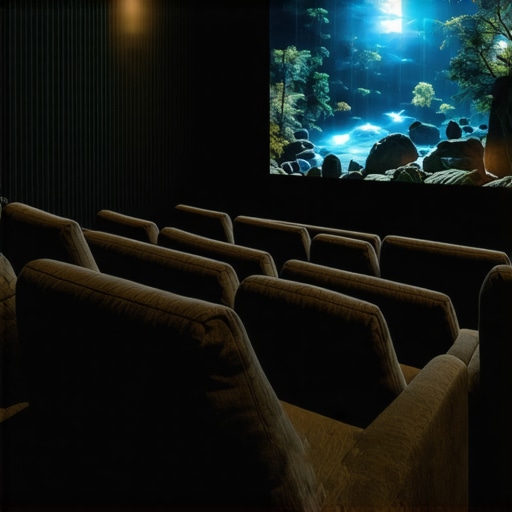
Enhancing Visual Depth and Atmosphere Through Strategic Lighting
Creating a captivating home theater experience hinges on meticulous lighting design that balances functionality with immersive ambiance. As an industry expert, I emphasize the importance of integrating backlight and ambient lighting to elevate viewing comfort, reduce eye strain, and foster a cinematic atmosphere that rivals commercial cinemas. Properly executed lighting schemes serve as the backbone of sensory engagement, transforming ordinary spaces into extraordinary entertainment hubs.
The Science Behind Ambient and Backlight Synergy for Visual Clarity
Advanced understanding of luminance interactions reveals that ambient lighting reduces contrast strain, while backlighting enhances perceived depth and color vibrancy. Techniques rooted in color temperature management, such as employing flicker-free LED strips with adjustable hues, allow for precise control over mood and focus. Aligning light temperature with screen content mitigates viewer fatigue, a concept supported by recent research published in the Journal of Visual Ergonomics.
Choosing the Optimal LED Strips for Dynamic Environments
Expert selection of LED strip lighting involves considerations of lumen output, color rendering index (CRI), and compatibility with smart home systems. The latest innovations, including addressable RGBW LED strips, facilitate complex lighting scenes that adapt to content or user preferences. For detailed guidance, refer to our comprehensive LED strip selection guide.
Installation Techniques that Maximize Aesthetic and Functional Gains
Professional installation entails strategic placement—such as cove lighting in soffits, behind the screen, or along architectural features—to ensure even illumination without glare. Utilizing diffusers and dimmable controllers, installers craft seamless backlight effects that accentuate screen edges and provide a soft glow that enhances spatial perception. For innovative ideas, explore our installation tips.
How Can Complex Lighting Schemes Be Tailored to Different Content Types?
Adapting ambient lighting to the nature of the content—be it a suspense thriller, vibrant animation, or documentary—requires a nuanced approach. Dynamic lighting setups that respond to scene changes can dramatically boost immersion. Integrating smart controls and scene presets allows users to effortlessly switch between lighting moods, thereby optimizing the viewing experience for every genre.
What Are the Technical Challenges in Synchronizing Backlight and Ambient Lighting for Seamless Transitions?
Synchronization involves complex timing and calibration, especially when dealing with multiple light sources and varying content luminance. Advanced DMX or Zigbee protocols enable precise control, but require expert setup to prevent flicker, lag, or mismatched color temperatures. Ongoing innovations in sensor-based adaptive lighting continue to push the boundaries of what’s achievable in home theater environments.
To explore further, consider reviewing our detailed ultimate guide to bias lighting for comprehensive insights. For a community of professionals and enthusiasts, sharing your own nuanced solutions can contribute significantly to advancing home theater lighting standards.
Fine-Tuning Light Transitions for Cinematic Flow
One of the most sophisticated aspects of home theater lighting is achieving smooth, synchronized transitions that complement scene changes without distraction. This involves not just setting static scenes but programming complex sequences that adapt in real-time to the content. Using programmable controllers with advanced protocols such as DMX or Zigbee, designers can craft seamless fades and color shifts, ensuring that the lighting enhances storytelling rather than competing with it.
For example, during a suspenseful thriller, gradually dimming ambient lights while intensifying backlighting on the screen can heighten tension. Conversely, brightening the room during lighter moments ensures viewers remain comfortable and alert. Experts recommend integrating sensors and AI-driven controls that analyze luminance and content mood, allowing dynamic adjustments that feel natural and immersive. To develop a robust system, consulting specialized guides on bias lighting setup can provide essential technical insights.
Challenging Assumptions About Color Temperature and Content Suitability
Many enthusiasts assume that warmer temperatures always create a cozy vibe, while cooler tones are better for clarity and focus. However, this dichotomy oversimplifies the nuanced role of color temperature in different content genres. For instance, vibrant animation benefits from a slightly cooler, more vibrant palette, while horror films may require dimmer, warmer hues to amplify suspense. The key lies in understanding how adjustable, flicker-free LED strips can be calibrated to match scene content, thereby preventing viewer fatigue and enhancing color accuracy.
Recent studies, such as those published in the Journal of Visual Ergonomics,
highlight that dynamic adjustments to color temperature not only improve visual comfort but also extend viewing endurance. This means that a flexible lighting system, which can shift between warm and cool tones based on content, provides a tailored experience that respects viewer physiology while maintaining immersive quality.
How Can Adaptive Lighting Be Customized for Different Viewing Preferences?
Personalization remains a core challenge in advanced home theater lighting. While preset scenes offer convenience, integrating user preferences through smart apps and voice controls allows for bespoke adjustments. Whether you prefer a dim, warm glow for late-night movies or a vibrant, cool ambiance for daytime viewing, modern LED systems can be fine-tuned to match individual tastes. This not only elevates user satisfaction but also encourages experimentation with different setups, pushing the boundaries of home entertainment design.
If you’re interested in expanding your knowledge, exploring our comprehensive top ambient lighting ideas offers practical tips to elevate your setup. Sharing your insights and experiences can contribute to community-driven innovations, helping others achieve their perfect cinematic ambiance.
Elevate Visual Dynamics with Layered Lighting Strategies
Creating an immersive home theater experience demands more than just installing LED strips; it requires a nuanced understanding of layered lighting design that can adapt to various content and user preferences. Incorporating multiple lighting layers—such as accent, task, and ambient lighting—allows for a flexible environment that enhances depth perception and emotional impact. For example, subtle accent lights behind architectural features can provide visual cues that frame the screen, while adjustable ambient lighting sets the overall mood. This multi-tiered approach ensures that lighting complements the content without overwhelming it, fostering a rich, cinematic atmosphere.
Harnessing the Power of Dynamic Scene-Based Lighting for Content Synchronization
Advanced home theater setups leverage scene-based lighting that responds in real-time to the content playing. Utilizing protocols like DMX512 or Zigbee, integrated lighting systems can synchronize with video playback, creating a seamless transition between scenes. For instance, during a tense thriller, gradually dimming ambient lights while intensifying backlighting on the screen can heighten suspense, whereas bright, vibrant lighting can energize a lively musical. Implementing such dynamic lighting requires precise calibration and often AI-driven automation to adapt to scene luminance and color schemes, making the experience both immersive and natural.
What Role Do Color Science and Spectral Optimization Play in Enhancing Home Theater Lighting?
Color science plays a pivotal role in designing lighting that accurately complements high-definition displays. Spectral optimization involves selecting LED light sources with specific spectral power distributions that enhance color fidelity and contrast. According to a comprehensive study published in the IEEE Transactions on Consumer Electronics, properly calibrated spectral profiles reduce color distortion and eye fatigue, enabling viewers to enjoy extended viewing sessions without discomfort. This scientific foundation informs the selection of LED products that deliver not just brightness, but also perceptual accuracy, vital for discerning color nuances in cinematic content.
Integrating spectral data into your lighting design elevates the visual experience, allowing for tailored adjustments that match the specific content genre—be it vibrant animation or moody noir films. For professionals and enthusiasts aiming for precision, consulting spectral measurement data provided by LED manufacturers or conducting your own spectral analysis can be game-changers in achieving true color harmony.
Implementing Advanced Control Systems for Precise Lighting Management
The backbone of sophisticated lighting schemes lies in control systems capable of managing multiple zones and scenes with granular precision. Modern solutions utilize wireless protocols like Zigbee or Z-Wave, integrated with smart home ecosystems, to enable remote and automated adjustments. Using programmable controllers, you can craft complex lighting sequences that activate based on time, content cues, or user input. For example, a single tap on a remote or app can transition your room from a neutral daytime setting to a dramatic cinematic environment, with lights fading, color shifting, and backlighting intensifying in harmony with the scene.
Expert installation involves meticulous calibration of each zone, ensuring that transitions are smooth and free of flicker or lag. Incorporating sensors—such as luminance or proximity detectors—further enhances responsiveness, creating an adaptive environment that dynamically responds to both content and user behavior. For those seeking the ultimate control, exploring integrations with AI-driven systems capable of learning preferences over time can open new dimensions of customization and immersion.
Future Trends in Home Theater Lighting: AI, Augmented Reality, and Beyond
The horizon of home theater lighting is rapidly expanding, driven by innovations in AI, augmented reality (AR), and sensor technology. AI algorithms are increasingly capable of analyzing scene content in real-time, adjusting lighting parameters instantaneously to optimize viewer comfort and immersion. AR overlays could even allow users to visualize lighting effects in their space before implementation, ensuring a perfect match with their aesthetic and functional goals. As technology evolves, expect to see more intuitive, adaptive systems that seamlessly blend lighting with content, creating environments that are not just aesthetically pleasing but also cognitively optimized for entertainment.
For those eager to stay at the cutting edge, participating in professional forums, attending industry expos, and experimenting with emerging products can provide invaluable insights. Explore our dedicated future trends in home theater lighting to stay informed and inspired—your next breakthrough in cinematic ambiance awaits.
Harnessing Spectral Optimization for True Color Fidelity
Achieving authentic color reproduction in a home theater environment demands meticulous spectral management. Spectral optimization involves selecting LED light sources with tailored spectral power distributions that align with high-definition display outputs. According to a detailed study published in the IEEE Transactions on Consumer Electronics, precise spectral calibration reduces color distortion and enhances contrast, resulting in a more immersive viewing experience. Experts recommend integrating spectrally optimized LED modules that can be fine-tuned for specific content genres, from vibrant animations to cinematic noir.
Innovating Control Protocols for Seamless Scene Transitions
Advanced control systems utilizing protocols like DMX512, Zigbee, or Z-Wave facilitate complex lighting choreography synchronized with content dynamics. These systems enable granular management of multiple zones, allowing for nuanced scene transitions that mimic professional cinemas. For example, during a tense thriller, gradual dimming of ambient light combined with intensified backlighting heightens suspense without distracting the viewer. Implementing AI-powered automation further refines these transitions, making them feel natural and emotionally resonant. Consult industry-leading resources such as our comprehensive control system guide for in-depth insights.
What Strategies Enable Content-Adaptive Lighting Without Distraction?
Content-adaptive lighting employs real-time analysis of video luminance and scene mood, adjusting light intensity and color temperature dynamically. This approach enhances immersion and minimizes eye fatigue, especially during prolonged viewing sessions. Techniques include integrating luminance sensors, AI algorithms, and scene recognition software to automate adjustments. For instance, during a high-action sequence, lighting can subtly shift to emphasize the on-screen energy, while during quiet moments, it dims to foster intimacy. The key challenge lies in calibrating sensors and software to prevent flicker or lag, which can detract from the cinematic experience. Exploring tools like our advanced bias lighting solutions can help optimize this process.
How Can Adaptive Lighting Personalization Elevate Viewer Comfort?
Personalization extends beyond preset scenes, leveraging smart control interfaces and voice commands to tailor ambient conditions to individual preferences. Users can choose subtle warm glows for late-night viewing or vibrant cool tones for daytime sessions, all managed via intuitive apps or voice assistants. This flexibility not only enhances comfort but also fosters experimentation, encouraging users to discover their ideal cinematic environment. Implementing machine learning algorithms that learn user habits and automatically adjust settings can further elevate this experience, creating a truly bespoke home theater atmosphere. For innovative ideas, review our top ambient lighting tips.
Integrating Multi-Layered Lighting to Amplify Visual Depth
Creating an immersive ambiance involves layering different lighting types—accent, task, and ambient—each calibrated to complement the cinematic content. Accent lighting behind architectural features or along the ceiling perimeter adds depth, while task lighting ensures practical visibility without glare. Dimmable, color-adjustable fixtures enable seamless transitions that enhance spatial perception and emotional engagement. By orchestrating these layers with advanced controllers, designers craft environments that adapt intuitively to content mood, heightening the sense of realism and immersion in the viewer.
Future-Proofing Home Theater Lighting with Cutting-Edge Technologies
The trajectory of home theater lighting is shaped by innovations in AI, augmented reality (AR), and sensor integration. AI algorithms can analyze scene content in real-time, adjusting lighting parameters for optimal comfort and immersion. AR tools allow users to visualize potential lighting arrangements before implementation, reducing trial-and-error. Moreover, sensor-based adaptive systems monitor luminance and scene changes, ensuring seamless synchronization. Staying ahead involves engaging with industry expos, participating in professional forums, and experimenting with emerging products. For a glimpse into upcoming trends, explore our future trends resource.
Revolutionize Your Setup with Strategic Layering
Implementing multi-tiered lighting techniques enhances cinematic immersion. Expert advice suggests combining accent, task, and ambient lighting for depth and emotional resonance, transforming ordinary rooms into professional-grade theaters.
Leverage Real-Time Content Synchronization
Advanced control protocols like DMX512 and Zigbee enable dynamic scene-based lighting that responds instantly to content changes. This approach heightens tension and excitement, elevating your viewing experience to a professional level.
Prioritize Spectral Optimization for Authentic Colors
Utilize spectrally calibrated LED sources to achieve true-to-life colors. Recent research underscores the importance of spectral power distributions in reducing distortion and eye fatigue, critical for discerning cinematic details.
Incorporate Adaptive, Personalized Lighting Solutions
Smart systems that learn user preferences allow for bespoke lighting environments. Personalized presets and voice control foster comfort and experimentation, ensuring each viewing session is perfectly tailored.
Stay Ahead with Emerging Technologies
Emerging AI and AR integrations promise seamless, intuitive control and visualization of lighting schemes. Engaging with industry innovations keeps your home theater at the forefront of entertainment technology.



Leave a Reply