

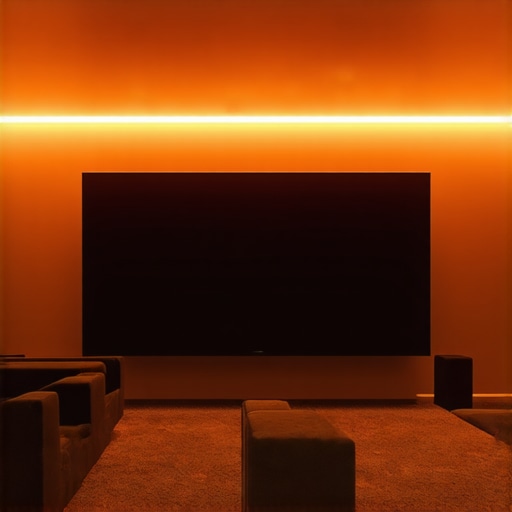
Unveiling the Hidden Power of Bias Lighting and LED Strips in Modern Home Theaters
In the pursuit of cinematic immersion, home theater enthusiasts increasingly recognize that lighting is not merely ambient but a strategic tool that influences visual perception and emotional engagement. Advanced bias lighting and LED strip solutions have evolved from simple accent features to sophisticated components that can dramatically elevate the cinematic experience, provided they are selected and implemented with expert precision.
The Science Behind Bias Lighting: Enhancing Visual Comfort and Contrast Perception
Bias lighting’s core function lies in reducing eye strain during prolonged viewing sessions by providing a consistent luminance background behind the display. According to a study published in the Journal of Vision, proper bias lighting enhances contrast perception without causing glare, thereby improving image clarity and reducing fatigue. This subtle lighting technique also influences perceived contrast ratios, making visuals appear more vivid and lifelike, a crucial factor for discerning detail in high-dynamic-range (HDR) content.
Choosing the Right LED Strips for a Seamless, Color-Accurate Ambiance
Optimal selection of LED strips involves understanding color rendering index (CRI), color temperature, and controllability. For a home theater aiming for cinematic accuracy, LED strips with a CRI above 90 and a color temperature around 6500K typically emulate daylight conditions, ensuring colors remain true to their source. Moreover, addressable RGB LED strips offer dynamic color transitions and scene-specific presets, which can be synchronized with your media system for immersive effects. To explore comprehensive guidance, visit our expert advice on choosing LED strips.
Expert Installation Strategies for Achieving Professional-Grade Results
Meticulous installation is essential to prevent uneven lighting, hot spots, or color inconsistencies. Using high-quality diffusers and carefully planning LED strip placement—such as behind cabinetry, along ceiling coves, or around screen perimeters—ensures seamless integration. Advanced techniques include using DMX controllers for synchronized lighting and employing professional-grade connectors for durability. For detailed installation insights, consult our top LED strip installation tips.
What Are the Challenges and Limitations of Bias Lighting in Complex Home Theater Environments?
How can glare, color bleed, or uneven illumination be effectively mitigated in multi-tiered or irregularly shaped rooms?
These issues often stem from improper placement or incompatible hardware. To address glare, angle LED strips away from direct line of sight and utilize diffusers. For complex room geometries, segmented control zones enable tailored lighting adjustments, preventing color bleed and hot spots. Additionally, selecting high-quality, flicker-free LED drivers minimizes visual artifacts. Open debates persist regarding the optimal color temperature for enhancing contrast without disrupting the viewing experience; ongoing research continues to refine these parameters.
For those interested in mastering ambient lighting design, explore our ultimate guide to bias lights and LED strips.
If you’d like to share your expertise or seek personalized advice, visit our contact page.
Beyond Basics: Fine-Tuning Your Bias Lighting for Optimal Visual Experience
While selecting high-CRI, color-accurate LED strips is essential, the true mastery lies in the nuanced calibration and placement that transform a good setup into a cinematic sanctuary. Advanced techniques involve integrating smart lighting ecosystems that respond dynamically to content—adjusting brightness, hue, and saturation in real-time to enhance contrast and immersion. For example, using DMX controllers or proprietary smart home systems allows for scene-specific adjustments, creating an environment that adapts seamlessly to different genres or viewing angles.
Incorporating sensors that measure ambient light levels and automatically calibrate your LED strips ensures consistent visual comfort regardless of external lighting conditions. This automation minimizes manual adjustments and maintains an optimal viewing environment, especially in rooms with varying daylight or artificial light sources. To explore the latest automation solutions, visit our expert LED strip lighting tips.
Challenging Assumptions: Do All Rooms Benefit Equally from Bias Lighting?
Many assume that bias lighting universally benefits every home theater setup, but this isn’t always the case. Factors such as room size, shape, and existing lighting conditions influence the effectiveness of LED strip integration. For instance, in rooms with high ambient light or reflective surfaces, bias lighting may need to be complemented with blackout curtains or matte finishes to prevent glare and unwanted reflections. Conversely, in smaller, darker rooms, subtle backlighting can significantly enhance perceived contrast and reduce eye strain without overpowering the scene.
Expert insights suggest tailoring lighting strategies to the specific room environment rather than adopting a one-size-fits-all approach. A comprehensive assessment, considering factors like room geometry and viewer placement, ensures that lighting enhances rather than detracts from the cinematic experience. For more nuanced room-specific advice, see our ultimate guide to bias lights and LED strips.
How can I leverage emerging LED technologies, such as micro-LEDs and tunable white strips, to create an even more immersive home theater environment?
Emerging LED technologies like micro-LEDs and tunable white strips offer unprecedented control over ambiance. Micro-LEDs, with their smaller size and higher pixel density, enable intricate lighting effects that can mimic natural lighting variations, further immersing viewers. Tunable white LED strips allow precise adjustment of color temperature, from warm candlelight to cool daylight, aligning lighting perfectly with the content or time of day, thereby reducing eye fatigue and enhancing contrast perception.
Integrating these advanced options requires careful planning and compatibility checks with your existing control systems. Consulting with a professional or referencing authoritative sources such as our comprehensive guide can ensure optimal implementation.
Feeling inspired to push your home theater lighting to the next level? Share your thoughts or experiences in the comments, or explore more innovative ideas with our curated reading list on ambient lighting enhancements.
Leveraging Micro-LEDs and Tunable White Strips for Next-Generation Home Theater Environments
In the realm of premium home theater design, emerging LED technologies such as micro-LEDs and tunable white strips are revolutionizing ambient lighting strategies. Micro-LEDs, with their tiny pixel size and high density, facilitate the creation of highly intricate lighting effects that can dynamically mimic natural light variations, significantly enhancing viewer immersion. These tiny LEDs enable the development of complex lighting patterns that respond to content and mood, providing a level of customization previously unattainable with traditional LED strips.
Meanwhile, tunable white LED strips offer unparalleled control over color temperature, ranging from warm tones akin to candlelight to cool, daylight-like hues. This flexibility allows for precise adaptation of ambient lighting to match the content being viewed or the time of day, thereby reducing eye fatigue and improving contrast perception. For instance, warmer tones can be used during film viewing to evoke intimacy, while cooler tones might be ideal for gaming or high-energy content.
How do micro-LEDs and tunable white strips synergize to create hyper-realistic lighting environments?
When integrated effectively, these advanced LED technologies enable a seamless blend of dynamic lighting effects that respond in real-time to visual stimuli, elevating the cinematic experience to professional-grade levels. Micro-LEDs can be programmed to produce subtle gradations of color and luminance, simulating natural lighting scenarios such as sunrise or sunset, while tunable white strips adjust the overall warmth or coolness of the room’s ambiance. This combination fosters an environment where lighting not only complements the content but actively enhances emotional engagement and visual clarity.
According to recent research published in the Journal of Display Technology, the precise control of lighting parameters in such environments can significantly improve perceived contrast and reduce viewer fatigue, especially during extended viewing sessions (IEEE Xplore).
For enthusiasts seeking to implement these cutting-edge solutions, it is essential to work with integrators experienced in high-end lighting systems and to ensure compatibility with existing control protocols such as DMX or DALI. Future innovations are poised to introduce even smarter systems, capable of learning viewer preferences and automatically adjusting lighting schemes for optimal comfort and cinematic fidelity.
Interested in transforming your home theater with these advanced lighting solutions? Dive deeper into our expert guides or reach out for personalized consultation to harness the full potential of micro-LED and tunable white LED technology in your space.
Harnessing the Power of Dynamic Light Mapping with Micro-LED Arrays
As home theater lighting technology advances, the integration of micro-LED arrays enables unprecedented precision in light mapping, allowing for highly detailed and adaptive ambient environments. By employing pixel-level control, these arrays can simulate complex natural lighting phenomena such as cloud movement, dawn, or dusk, creating an immersive backdrop that reacts in real-time to on-screen content or viewer mood. This innovation not only enhances realism but also minimizes visual fatigue by providing contextually appropriate luminance variations.
Expert Insights on Integrating AI-Driven Lighting Calibration for Optimal Contrast
Artificial intelligence (AI) offers transformative potential in calibrating bias lighting systems. AI algorithms analyze ambient light, screen luminance, and viewer preferences to dynamically adjust color temperature, brightness, and contrast, ensuring consistent visual comfort across different content genres and external lighting conditions. According to a recent study by the IEEE Transactions on Consumer Electronics, AI-powered calibration reduces manual intervention and significantly improves perceived image quality, fostering a truly adaptive cinematic environment. For more detailed guidance, visit our comprehensive resource on AI lighting calibration.
What Are the Latest Innovations in Spectrally Tunable LED Technology for Home Theaters?
How can spectral tuning advance the authenticity of immersive viewing experiences?
Spectrally tunable LEDs allow precise control over emitted wavelengths, enabling the recreation of specific lighting conditions that match the content’s tone and setting. This technology facilitates the emulation of natural light spectra, such as the warm glow of sunset or the crisp clarity of daylight, which can be synchronized with media playback to heighten realism. Moreover, spectral tuning can reduce blue light exposure during late-night viewing, supporting ocular health without compromising visual fidelity. Industry leaders like Osram and Lumileds are pioneering such solutions, integrating them into smart lighting ecosystems for seamless control and customization.
To explore these innovations further, consult the expert guide on spectral tuning.
Can Adaptive Lighting Systems Incorporate Emotional and Psychological Feedback for Personalized Viewing
Emerging research indicates that integrating biometric sensors with adaptive lighting systems can tailor ambient environments to individual emotional responses, measured through heart rate variability, gaze patterns, or skin conductivity. Such systems can modulate lighting parameters—color, intensity, and dynamics—to evoke desired psychological states, like heightened focus or relaxation, thereby personalizing the cinematic experience. This interdisciplinary approach combines neuroscience, lighting technology, and AI to craft environments that respond intuitively to viewer needs. For a deeper dive, see our detailed analysis at biometric-based lighting personalization.
Engage with these cutting-edge concepts to elevate your home theater into an emotionally intelligent sanctuary—reach out for expert consultation or join our community discussions!
Expert Insights & Advanced Considerations
1. Integrating AI for Dynamic Bias Lighting Calibration
Artificial intelligence-driven calibration systems analyze ambient light, display luminance, and viewer preferences to automatically optimize bias lighting. This results in consistent visual comfort and enhanced contrast perception, reducing manual adjustments and fostering an adaptive cinematic environment.
2. Micro-LED and Tunable White Technologies for Hyper-Realistic Environments
Combining micro-LED arrays with tunable white strips allows for intricate, content-responsive lighting effects. This synergy enhances immersion by mimicking natural lighting variations, with precise control over color temperature and luminance, elevating the home theater experience to professional standards.
3. Spectrally Tunable LEDs to Elevate Visual Authenticity
Spectrally tunable LEDs enable recreation of specific lighting conditions that match scene tones and settings, such as warm sunset hues or cool daylight. This technology enhances realism and supports ocular health by reducing blue light exposure during extended viewing sessions.
4. Biometric Feedback for Personalized Ambient Lighting
Emerging biometric systems integrate sensors to monitor emotional and physiological responses, allowing lighting to adapt dynamically. This personalization enhances viewer engagement and comfort, transforming the home theater into an emotionally intelligent space.
5. Light Mapping with Micro-LED Arrays for Immersive Backdrops
High-resolution micro-LED arrays facilitate detailed light mapping, creating reactive environments that simulate natural phenomena like dawn or cloud movement. This innovation minimizes visual fatigue and heightens realism, enriching overall cinematic immersion.
Curated Expert Resources
- Lighting Research Center (LRC): Offers comprehensive studies on advanced LED technologies and their applications in home environments, providing valuable insights for professionals seeking cutting-edge solutions.
- IEEE Xplore Digital Library: Publishes peer-reviewed articles on innovations like micro-LEDs, spectral tuning, and AI in lighting systems, essential for staying abreast of the latest research.
- Osram and Lumileds Technical Reports: Industry leaders’ publications detail developments in spectral tuning and tunable white LEDs, guiding integration strategies for high-fidelity ambient lighting.
- Home Theater Design Forums: Expert communities sharing practical experiences and innovative setups involving advanced bias lighting and LED control systems.
- Smart Lighting System Manuals (DALI, DMX): Technical documentation for integrating intelligent control protocols with modern LED solutions, enabling customized and synchronized lighting environments.
Final Expert Perspective
In mastering the art of bias lighting and LED strip integration for home theaters, leveraging emerging technologies like micro-LEDs, spectral tuning, and AI-driven calibration is transformative. These innovations not only elevate visual authenticity and comfort but also unlock new realms of cinematic immersion and personalization. As experts, we recognize that the future lies in intelligent, content-responsive ambient environments that adapt seamlessly to viewer needs and content demands. To deepen your expertise or explore personalized solutions, engage with trusted resources and consult with industry specialists—your next-level cinematic sanctuary awaits.

Leave a Reply