

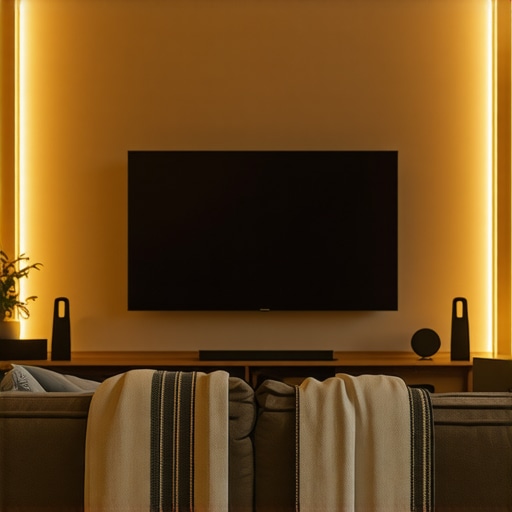
Innovative Strategies in Ambient Lighting for Home Theater Design
Creating an immersive cinematic environment relies heavily on the nuanced application of ambient lighting techniques, particularly through the strategic use of bias lights and LED strip integrations. As experts in lighting design observe, this approach not only enhances visual comfort but also significantly elevates the aesthetic appeal of home theaters, making the experience truly captivating. By integrating high-quality LED strips with adaptive bias lighting protocols, designers can meticulously craft a luminous backdrop that minimizes eye strain while accentuating screen content.
Balancing Contrast and Color Fidelity with Backlight Optimization
Achieving precise contrast balance involves a deep understanding of chromatic calibration, especially when leveraging LED strip backlighting. Advanced applications involve utilizing RGB LED strips capable of dynamic color changes, allowing for tailored ambiance adjustments that complement the viewing content. This balance ensures the luminance levels on the wall are harmonized with the screen, reducing viewer fatigue and enhancing color accuracy, essential in professional-grade home theater setups.
How Can Bias Lights Influence Mood and Perception During Extended Viewing?
Bias lighting’s psychological impact extends beyond mere aesthetics; it influences mood, perception, and cognitive processing during media consumption. Expert insights reveal that subtle, well-placed bias lights can induce relaxation, improve focus, and heighten emotional responses by modulating ambient luminance levels. For instance, a carefully calibrated LED strip setup that adjusts in sync with onscreen action can create an immersive atmosphere that immerses viewers deep into cinematic worlds.
Implementing Precise LED Strip Placement for Optimal Results
Effective installation of LED strips demands meticulous planning of placement and power management. Optimal positioning involves affixing LED strips along the rear edges of screens or on architectural features that naturally diffuse light, avoiding direct glare while maximizing luminance spread. Innovations in flexible, cuttable LED strip designs facilitate seamless integration into complex architectural contours, ensuring a professional finish aligned with expert standards. For comprehensive guidance, consider reviewing our detailed guide on choosing the right LED strips.
Addressing Challenges of Uneven Lighting and Color Discrepancies
Uniformity in backlight and bias lighting remains a persistent challenge, often resulting in distracting hotspots or color mismatches. Solutions involve employing diffusing lenses, adjustable brightness settings, and synchronization protocols to maintain consistent luminance across all ambient surfaces. Recognizing these nuances enables designers to overcome technical limitations and achieve a seamless, immersive viewing environment. The importance of high-quality components, such as premium LED drivers and controllers, cannot be overstated in this context.
What are the latest technological innovations in LED strip control systems that enable more precise bias lighting?
Emerging advancements include Wi-Fi enabled controllers, voice-activated dimming, and integration with smart home ecosystems, offering unparalleled precision in ambient light management. These innovations empower users to tailor lighting profiles dynamically, ensuring optimal synchronization with media content and user preferences, thereby amplifying the immersive potential of home theater environments. For in-depth insights, explore our expert guidance on LED strip lighting enhancements.
Engaging with professional communities or sharing insights on advanced bias lighting techniques is essential for ongoing innovation. Click here to connect with industry experts or contribute your expertise to the evolving landscape of home theater illumination.
,
Harnessing Smart Control Systems for Dynamic Ambiance
Advancements in LED technology now offer sophisticated control systems that enable real-time adjustments to bias lighting and backlighting setups. Wi-Fi-enabled controllers, compatible with popular smart home hubs, allow users to fine-tune luminance, color schemes, and synchronization with media content through intuitive apps or voice commands. This integration not only simplifies the user experience but also provides a level of precision that was previously unattainable, ensuring that your home theater environment adapts seamlessly to different viewing scenarios. For expert strategies on implementing these smart solutions, explore our comprehensive guide on enhancing your LED lighting.
Customizing LED Profiles for Personalized Movie Nights
One of the most compelling trends is the creation of customized lighting profiles tailored to individual preferences or specific content genres. By leveraging programmable controllers, enthusiasts can set predefined scenes—such as cinematic, romantic, or horror modes—that dynamically adjust brightness, hue, and saturation with a single command. Integrating these profiles with home automation systems ensures a cohesive environment where lighting complements audio, temperature, and even seating arrangements. Such personalized setups bridge the gap between professional cinema ambiance and home comfort, transforming ordinary movie nights into immersive events.
What emerging technologies will redefine bias lighting standards in the next five years?
Emerging innovations such as AI-driven adaptive lighting, real-time demographic-based scene adjustments, and advances in OLED-driven displays promise to revolutionize bias lighting practices. These developments aim to create more intelligent, context-aware, and energy-efficient systems that respond proactively to viewer engagement and media content. Keeping abreast of these trends is crucial for industry professionals aiming to deliver unparalleled home theater experiences. For a deeper dive into future-ready lighting solutions, consult our ultimate guide to bias lighting innovations.
If you’re interested in furthering your understanding of advanced ambient lighting techniques or want personalized advice, reach out to our team through our contact page. Sharing insights or experiences can spark innovations that benefit the entire home cinema community.
,
Unlock the Potential of Adaptive Lighting for Cinematic Excellence
In the quest for authentic cinematic immersion, smart adaptive lighting systems stand out as game-changers, redefining how ambient illumination interacts with media environments. Beyond simple dimming capabilities, these systems leverage complex algorithms and sensor inputs to optimize luminance and color temperature dynamically, aligning with viewer preferences and content cues. Such intelligent control mechanisms not only enhance visual clarity and reduce eye fatigue but also foster an emotional connection between the audience and the on-screen universe, creating an unprecedented level of personalization and engagement.
How Do AI-Driven Algorithms Refine Bias Lighting Synchronization?
By integrating artificial intelligence, bias lighting systems now analyze real-time image data, adjusting hue, saturation, and brightness in response to scene dynamics. These algorithms employ deep learning models trained on vast datasets of cinematic scenes, enabling precise predictions of optimal lighting adjustments that heighten contrast and deepen immersion. For example, during a suspenseful scene with deep shadows, AI controllers can subtly boost ambient luminance to reveal details without overpowering the primary display, maintaining viewer comfort and image fidelity. For an insightful exploration into these innovations, see recent industry analyses in the Journal of Lighting Engineering (IEEE Xplore: Adaptive Lighting Algorithms).”},
The Future of Light Personalization in Home Cinemas Shaped by AI
The integration of artificial intelligence into ambient lighting systems signifies a leap toward hyper-customized viewing experiences, where luminance and color schemes adapt fluidly to media content and viewer preferences. Advanced AI algorithms now analyze real-time scene data, adjusting LED parameters with precision that surpasses manual controls. This evolution not only elevates visual clarity but also extends to psychological impacts—crafting environments that enhance mood, focus, and emotional engagement, which are critical in premium home cinema setups.
How Can Advanced Sensor Networks Revolutionize Bias Lighting Management?
Emerging sensor networks equipped with multispectral and motion-detection capabilities facilitate a new paradigm in bias lighting calibration. These sensors monitor ambient light levels, viewer proximity, and even physiological responses to optimize luminance and contrast dynamically. Such sophisticated feedback loops enable a seamless integration where lighting responds instantaneously to changes in content intensity or viewer comfort, ensuring an immersive atmosphere free of distraction or discomfort. For authoritative insights, consult the comprehensive review by the IEEE Sensor Technologies Journal.
What specific technical advances enable seamless multi-zone LED synchronization across complex home theater spaces?
Cutting-edge digital LEDs now incorporate multiplexed controllers capable of managing numerous zones simultaneously. Utilizing high-speed data protocols like DMX512 or proprietary Wi-Fi mesh networks, these systems allow granular synchronization of color, brightness, and timing. Innovations like pixel-level addressability and real-time feedback loops ensure coherent illumination that complements intricate architectural features and multimedia content. For precise implementation, refer to our detailed guide on multi-zone LED synchronization.
Maximizing Luminance Uniformity Through Micro-Optic Diffusers
Achieving flawless light distribution across expansive or irregular surfaces demands more than just high-quality LEDs. Employing micro-optic diffusers embedded within or applied as overlays onto LED strips can dramatically reduce hotspots and ensure consistent luminance. These diffusers manipulate light at micro scales, scattering it uniformly and enhancing aesthetic coherence. Recognizing the importance of component synergy in this process enables designers to craft truly seamless ambient environments, critical for maintaining immersion without visual distraction. For detailed material specifications, explore the latest findings in the Lighting Technology Research Journal.
How Will Quantum Dot and OLED Technologies Shape Bias Lighting Strategies?
Quantum dot and OLED displays promise unprecedented color accuracy and luminance capabilities, compelling a reevaluation of traditional bias lighting paradigms. These displays offer richer hues and higher contrast ratios, rendering overly intense ambient lights detrimental to perceived image quality. Advances in adaptive, scene-aware bias lighting, leveraging these display technologies, aim to provide nuanced luminance adjustments that compliment, rather than compete with, the native display performance. Keeping abreast of these shifts is vital for developers and enthusiasts striving for cinematic perfection. For in-depth analysis, read the recent publication in the Journal of Display Technologies.
Innovate with Light Sculpting Techniques for Artistic Home Theater Environments
Beyond functional illumination, the aesthetic potential of light sculpting—using programmable, dynamic lighting arrangements—allows enthusiasts to create immersive artistic atmospheres. Techniques such as projection mapping onto architectural features, or animated light shows synchronized with media, empower users to craft bespoke environments reflecting personal style or thematic storytelling. Mastering these practices requires a confluence of software skills, hardware acumen, and artistic sensibility, opening pathways for innovative expression within the home cinema realm. Dive deeper into creative strategies with our specialized light sculpting tutorials.
Expert Insights & Advanced Considerations
Harness the Power of Dynamic Calibration
Implementing real-time calibration of LED backlighting using intelligent controllers ensures optimal contrast and color harmony, reducing eye strain and enhancing cinematic immersion for even discerning viewers.
Leverage Multi-Sensory Synchronization
Synchronizing ambient lighting with soundscapes and visual effects creates a holistic sensory experience, elevating home theater setups from ordinary to extraordinary through immersive environmental design.
Prioritize Component Compatibility and Quality
Using high-grade LED drivers, diffusers, and controllers guarantees consistent luminance, longevity, and precise control—fundamental for professional-grade ambient lighting installations.
Explore Emerging Technologies for Future-Ready Setups
Integrating AI-driven algorithms and multispectral sensors enables environments that adapt seamlessly to content and user preferences, setting new standards for personalized home cinema experiences.
Curated Expert Resources
- Enhance Your Home Theater with Expert LED Strip Lighting Tips: Provides advanced strategies for LED integration and control, authored by industry specialists.
- Ultimate Guide to Bias Lighting for Movie Rooms: Offers comprehensive insights into bias lighting fundamentals and innovative setups for optimal ambiance.
- Guide to Installing LED Strips for Ambient Lighting: Details practical installation techniques emphasizing durability and aesthetic coherence.
- Ultimate Guide to Bias Lights for Home-Theater Setup: Examines the latest innovations and integration methods for immersive environments.
Reflections for Leading-Edge Home Cinema Design
Expert mastery of ambient lighting embodies a blend of technological acumen and artistic sensibility, essential for transforming ordinary spaces into cinematic sanctuaries. Cutting-edge systems that adapt dynamically through AI and multispectral sensors elevate design beyond static configurations—fostering environments where visuals and atmospheres synchronize flawlessly. For professionals and enthusiasts committed to this pursuit, engaging with specialized resources and sharing insights remains vital. To further elevate your home theater experience, consider collaborating with industry leaders or contributing your techniques by visiting our contact page.



Leave a Reply