

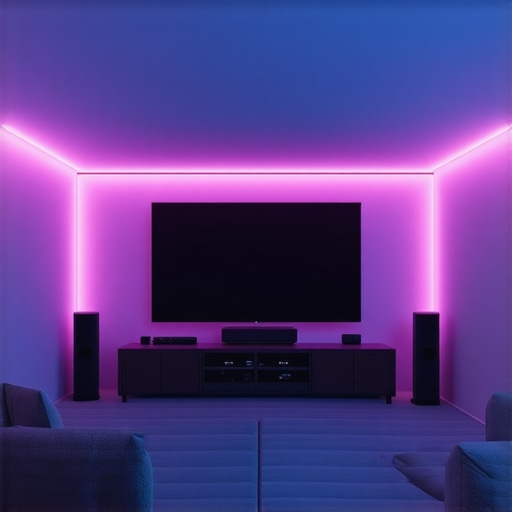
Strategic Significance of Bias Lighting in Enhancing Modern Home Theater Ecosystems
In the realm of high-fidelity home entertainment, bias lighting emerges as a critical component for optimizing visual comfort and cinematic immersion. Experts recognize that proper bias lighting, when integrated with state-of-the-art LED strips, not only reduces eye strain but also enhances contrast perception, thereby elevating the viewing experience to near-professional cinema standards. As we progress into 2024, understanding the nuanced interplay between LED technology advancements and ergonomic lighting design becomes essential for enthusiasts and professionals alike.
Technological Innovations Shaping the Future of LED Strips for Home Theaters
The evolution of LED strip technology now encompasses high CRI (Color Rendering Index) ratings, ultra-smooth dimming capabilities, and spectrum tuning options. These innovations facilitate precise control over ambient lighting, allowing for dynamic scene adaptation that aligns with content type—be it HDR movies or gaming sessions. Furthermore, the integration of smart home compatibility and voice control enhances user experience, making LED strips seamlessly adaptable to personalized lighting protocols. For detailed guidance on selecting the right LED strips, consult the expert guide to choosing LED strips.
Designing Bias Lighting Systems for Optimal Visual Comfort and Aesthetic Cohesion
Creating an immersive home theater environment involves more than just selecting high-quality LED strips. It requires a strategic approach to placement, color temperature, and brightness levels that harmonize with screen size and room acoustics. Expert recommendations suggest positioning bias lights behind or along the sides of the display to minimize glare and reflections. Additionally, employing layered lighting, including accent and task lights, can significantly enhance aesthetic appeal while maintaining functional illumination. For inspiration, explore top ambient lighting ideas.
Addressing the Complexities of Color Accuracy and Flicker-Free Operation in LED Strips
One of the persistent challenges in deploying LED strips is maintaining color fidelity and flicker-free operation, especially at high refresh rates needed for cinematic quality. Advanced LED models incorporate high-frequency PWM (Pulse Width Modulation) to eliminate flicker, which is crucial for avoiding eye fatigue during extended viewing. Moreover, calibration for color temperature consistency ensures that bias lighting complements the onscreen content without introducing color distortions. Industry-standard references, such as those detailed in academic journals like the Journal of Display Technology, provide insights into these technical specifications.
What are the best practices for integrating bias lighting with existing AV equipment to ensure synchronized ambiance?
Expert integration involves configuring smart lighting controls to synchronize with AV sources, utilizing HDMI-CEC or proprietary apps for real-time adjustments. This ensures that lighting adapts dynamically to content, enhancing immersion without distracting the viewer. For comprehensive setup strategies, see the ultimate guide on bias lighting setup.
To further refine your home theater lighting system, consider engaging with professional forums or consulting with specialized lighting designers. Your insights can contribute to evolving best practices, fostering a community of high-performance home cinema enthusiasts.
Harnessing Synchronization Technologies to Elevate Your Home Theater Ambiance
In the pursuit of a truly immersive cinematic experience, the synchronization of bias lighting with audiovisual content is a game-changer. Modern LED strip systems now leverage sophisticated technologies such as HDMI-CEC, Wi-Fi, and Zigbee protocols to seamlessly align lighting effects with on-screen action. This integration not only heightens visual cohesion but also minimizes potential distractions, creating a harmonious environment that adapts dynamically to your viewing content. For a comprehensive understanding of integrating smart lighting with AV equipment, visit the ultimate guide to bias lighting setup.
What Are the Technical Challenges and Solutions in Achieving Perfect Sync?
One of the core technical challenges involves latency — the delay between content changes and lighting response. High-end systems utilize real-time data processing and low-latency controllers to mitigate this issue. Additionally, calibration tools such as spectrometers and colorimeters can be employed to fine-tune the spectrum output, ensuring that the bias lighting complements the scene without introducing color inaccuracies. Industry standards like the HDMI 2.1 specification and advancements in flicker-free LED driver technology play pivotal roles in overcoming these hurdles, as detailed in the expert resource on bias lighting.
How can immersive lighting control systems be customized for various content types and user preferences?
Customization begins with selecting adaptable LED systems that support scene-based presets and granular control over brightness, color temperature, and saturation. Advanced control platforms, often compatible with popular smart home ecosystems like Alexa, Google Assistant, or Apple HomeKit, enable users to create tailored lighting profiles for different scenarios — from cinematic night-outs to casual gaming. Moreover, integrating sensor-based automation, such as ambient light sensors, allows the system to adjust lighting dynamically based on external light conditions, ensuring optimal viewing comfort at all times. For more insights into creating personalized lighting schemes, see the guidelines on immersive ambiance design.
If you’re interested in mastering the art of synchronized ambient lighting, sharing your experiences in the comments can foster a community of high-performance home cinema enthusiasts. Want to learn more about the latest innovations? Explore our top LED strip backlight ideas for 2024.
Harnessing Real-Time Data Processing for Seamless Bias Lighting Synchronization
Modern home theater enthusiasts are increasingly leveraging cutting-edge real-time data processing technologies to achieve near-instantaneous synchronization between visual content and bias lighting. High-performance controllers utilizing FPGA (Field Programmable Gate Array) and low-latency microprocessors enable the rapid analysis of HDMI signals or proprietary data streams, facilitating dynamic adjustment of LED color, brightness, and contrast. According to industry insights from the IEEE Transactions on Consumer Electronics, such systems can reduce latency to under 10 milliseconds, creating an almost imperceptible delay that maintains visual harmony and prevents distraction.
Implementing Adaptive Algorithms for Content-Aware Lighting Control
Beyond raw hardware capabilities, sophisticated software algorithms are pivotal for interpreting audiovisual data and modulating lighting parameters accordingly. Machine learning models trained on diverse content types can predict optimal lighting profiles, adjusting in real-time to scene changes, motion intensity, and emotional tone. For example, during intense action scenes, the system might subtly increase contrast or shift to cooler tones to heighten immersion, while during calm dialogues, it might favor warmer, softer hues. Researchers at the MIT Media Lab have demonstrated that adaptive algorithms can significantly enhance viewer engagement and reduce eye fatigue over extended viewing periods.
What Are the Nuances of Calibrating Bias Lighting to Prevent Color Contamination?
One of the more subtle challenges in high-precision bias lighting systems is avoiding color contamination—the phenomenon where bias lighting inadvertently alters the perceived hue of the onscreen content. This requires meticulous calibration of the LED spectrum using spectrometers and colorimeters, ensuring that the bias lighting spectrum is narrowband and does not bleed into the visible range of the display. Experts recommend employing spectral filters and high-CRI LEDs with spectral power distributions aligned to the D65 standard illuminant, as specified by the International Commission on Illumination (CIE). Such calibration ensures the bias lighting enhances contrast perception without distorting color fidelity, crucial for professional-grade color grading workflows.
How can integrating AI-driven scene recognition elevate home theater lighting systems?
Integrating AI-powered scene recognition enables the system to identify content genres, emotional tone, and specific scene elements—such as sunsets, night scenes, or action sequences—and adapt lighting parameters accordingly. For instance, during a sunset scene, the system might shift to warmer hues with increased saturation, creating a more authentic visual experience. Companies like Sony and LG are pioneering such features in their premium OLED and LED models, utilizing deep learning models trained on extensive media databases to deliver context-aware ambiance. This fusion of AI and intelligent lighting control not only enhances aesthetic appeal but also personalizes viewing experiences based on user preferences and ambient conditions.
For enthusiasts eager to implement or upgrade their systems, exploring open-source AI frameworks like TensorFlow combined with compatible smart lighting hardware can offer customizable solutions tailored to unique home environments. Engaging with online communities and professional consultancies can further refine these setups, ensuring synchronization accuracy and aesthetic harmony.
Interested in pushing the boundaries of your home theater setup? Dive deeper into emerging technologies and share your experiences with our community of high-end AV aficionados. For comprehensive guides and expert advice, visit our dedicated resource page on intelligent ambient lighting systems.
Innovative Methods for Precision Calibration of Bias Lighting to Achieve Cinematic Color Fidelity
Achieving impeccable color accuracy in bias lighting necessitates the deployment of high-precision spectrometers and advanced calibration protocols. Experts advocate for the utilization of spectral power distribution (SPD) measurements to fine-tune LED output, ensuring minimal spectral overlap and eliminating color contamination. Implementing high-CRI LEDs with spectral filters aligned to the D65 standard illuminant, as stipulated by the CIE, is paramount for professional-grade setups. Such meticulous calibration not only preserves the integrity of on-screen colors but also enhances contrast perception, elevating the home theater experience to a near-theatrical standard.
Emerging Technologies in AI-Driven Scene Recognition for Adaptive Ambient Lighting
The integration of artificial intelligence with real-time scene analysis introduces a new paradigm in ambient lighting control. By leveraging deep learning models trained on extensive media datasets, systems can dynamically interpret scene context—such as mood, genre, or specific visual elements—and adapt lighting parameters accordingly. This results in a highly personalized, immersive viewing environment that adjusts seamlessly to content nuances. Companies like Sony and LG are pioneering such AI-enhanced features, harnessing neural networks to optimize ambiance, thereby fostering an emotionally resonant cinematic experience.
What are the best practices for synchronizing bias lighting with high-refresh-rate gaming and cinematic content?
Synchronization excellence hinges on low-latency data processing and communication protocols. High-performance controllers utilizing FPGA technology and low-latency microprocessors can reduce delay to under 10 milliseconds, ensuring near-instantaneous lighting adjustments. Employing HDMI-CEC or proprietary APIs facilitates cohesive communication between AV sources and lighting systems. Additionally, calibration tools such as spectrometers and colorimeters ensure spectral alignment, preventing color distortions during rapid scene changes. Adhering to industry standards like HDMI 2.1 further guarantees compatibility and performance, as detailed in the IEEE Transactions on Consumer Electronics.
How can immersive, scene-aware lighting be customized for diverse user preferences and room acoustics?
Customization begins with selecting adaptable LED systems capable of scene-based presets, offering granular control over brightness, hue, and saturation. Integrating smart home ecosystems like Apple HomeKit, Google Assistant, or Alexa allows users to craft personalized profiles for different entertainment scenarios. Sensor-based automation, such as ambient light sensors, enables real-time adjustments responsive to external lighting conditions, optimizing visual comfort. Moreover, modular lighting architectures facilitate easy reconfiguration, accommodating room acoustics and layout peculiarities. For detailed implementation, consult the comprehensive guide on personalized ambient lighting.
What role does real-time data processing and machine learning play in elevating bias lighting synchronization?
Cutting-edge systems leverage FPGA and low-latency microprocessors to analyze AV signals instantaneously, enabling seamless synchronization that minimizes perceptible latency. Machine learning algorithms further refine this process by predicting optimal lighting adjustments based on scene content, emotional tone, and viewer preferences. For instance, during intense action sequences, the system might subtly enhance contrast or shift to cooler tones, heightening immersion. Researchers at MIT Media Lab demonstrate that adaptive algorithms can significantly improve viewer engagement and reduce eye fatigue, setting new standards for cinematic ambiance in home environments.
How can spectral tuning and advanced LED driver technology prevent color contamination in bias lighting systems?
Preventing color contamination requires spectral precision and high-quality LED drivers. Narrowband spectral tuning, achieved through spectral filters and high-CRI LEDs, ensures the bias lighting spectrum aligns closely with the D65 illuminant, reducing hue distortion. Employing flicker-free LED drivers with high-frequency PWM (Pulse Width Modulation) eliminates flicker artifacts, ensuring smooth, stable illumination. Industry standards, including those from the International Commission on Illumination (CIE), guide calibration practices to maintain color fidelity. Such meticulous spectral management enhances contrast perception without compromising onscreen color accuracy, vital for professional content creators and enthusiasts alike.
How can AI-powered scene recognition be further refined to enhance ambient lighting adaptation for various genres?
Advancements in deep learning enable scene recognition systems to classify content genres, emotional tones, and specific visual cues with increasing accuracy. By training neural networks on diverse datasets, systems can predict optimal lighting schemes—such as warmer tones for romantic scenes or cooler hues for sci-fi action—tailoring ambiance to content context. Incorporating user feedback and preferences refines these predictions, creating a truly personalized experience. Companies like Sony and LG are pioneering such AI-enabled features, pushing the boundaries of immersive home theater environments. Engaging with open-source AI frameworks like TensorFlow allows enthusiasts to customize and optimize these systems further, fostering innovation within the high-end AV community.
Ready to elevate your home theater ambiance? Explore our advanced guides and join discussions with fellow enthusiasts dedicated to perfecting synchronized, immersive lighting environments. For more in-depth insights and latest trends, visit our dedicated resource hub on intelligent ambient lighting systems.
Expert Insights & Advanced Considerations
1. Continuous Innovation in Spectrum Calibration Enhances Color Fidelity
Top-tier bias lighting systems now leverage spectral power distribution (SPD) measurements and narrowband LEDs to ensure precise color rendering, minimizing contamination and maintaining on-screen color accuracy—an essential for professional-grade home theaters.
2. AI-Driven Scene Recognition Elevates Immersive Experiences
Integrating deep learning models for real-time scene analysis allows adaptive lighting to match content mood and genre dynamically, creating a deeply personalized and emotionally resonant viewing environment that adapts seamlessly to cinematic nuances.
3. Low-Latency Data Processing Sets New Standards
Utilization of FPGA and advanced microprocessors reduces lighting response latency to under 10 milliseconds, ensuring synchronization that is imperceptible to viewers and maintains visual cohesion during rapid scene changes.
4. Spectral Tuning and Advanced Drivers Prevent Color Contamination
Employing spectral filters and flicker-free LED drivers, aligned with CIE standards, guarantees that bias lighting enhances contrast perception without distorting on-screen colors, vital for high-fidelity content creation and playback.
5. Modular, Scene-Aware Customization Meets Diverse User Preferences
Flexible, scene-based presets integrated with smart home ecosystems enable tailored ambiance, accommodating varying room acoustics, external lighting conditions, and user preferences for an optimized cinematic experience.
Curated Expert Resources
- IEEE Transactions on Consumer Electronics: Authoritative insights into real-time data processing and low-latency synchronization technologies for high-end AV systems.
- International Commission on Illumination (CIE): Standards and guidelines on spectral power distribution and calibration practices vital for color fidelity in bias lighting.
- MIT Media Lab Publications: Cutting-edge research on adaptive algorithms and machine learning models for scene-aware ambient lighting.
- Spectroradiometry and Colorimetry Textbooks: Technical references for spectral calibration, color contamination prevention, and professional-grade setup practices.
- Open-source AI Frameworks (TensorFlow, PyTorch): Tools for customizing scene recognition and adaptive lighting algorithms, fostering innovation among enthusiasts and professionals.
Final Expert Perspective
In the realm of high-performance home theater lighting, mastering the integration of spectral calibration, AI-driven scene recognition, and ultra-low latency synchronization elevates bias lighting from mere enhancement to an art form—one that demands technical precision and creative finesse. For professionals and enthusiasts committed to excellence, exploring these advanced facets and leveraging authoritative resources is essential for pushing the boundaries of immersive cinematic experiences. Engage with our community of experts and continue refining your system—your next breakthrough in ambient lighting awaits. For ongoing updates and expert guidance, visit our dedicated resource page.



Leave a Reply