

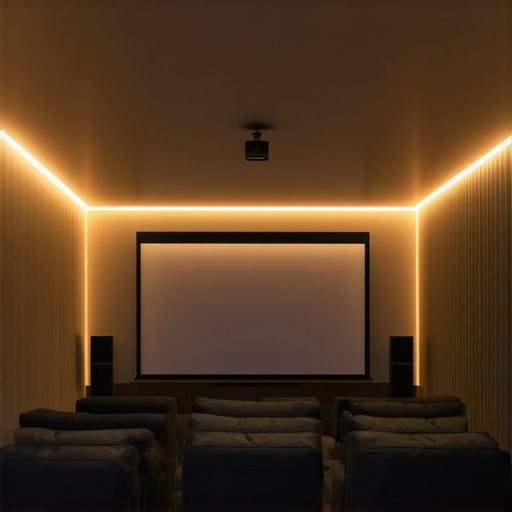
Mastering the Art of LED Strip Backlighting for Cinematic Ambiance
In the realm of immersive home theater design, the strategic deployment of LED strip lighting plays a pivotal role in crafting an authentic cinematic environment. Leveraging expert insights, this article explores advanced techniques to optimize ambient lighting, emphasizing the nuanced integration of backlighting and mood-enhancing LED strips. Understanding the interplay between light placement, color temperature, and dimming controls is essential for creating a visually cohesive and emotionally engaging movie experience.
Unlocking the Potential of Color Psychology in Ambient LED Lighting
Color selection in LED strips influences viewer perception and emotional response, with experts advocating for dynamic color schemes that adapt to film genres. For instance, cooler hues like blue and violet induce calmness for dramatic narratives, while warmer tones foster intimacy during romantic scenes. Integrating programmable RGB LED strips allows for real-time adjustments, enhancing immersion and providing a personalized viewing atmosphere. To explore diverse color schemes, refer to our top ambient lighting ideas.
Technical Considerations for Seamless LED Strip Integration
Achieving professional-grade ambient lighting necessitates meticulous planning of LED strip placement, power management, and control systems. Experts recommend installing LED strips behind wall panels, along ceiling coves, or beneath furniture edges to produce indirect illumination that reduces glare and eye strain. Additionally, choosing high CRI (Color Rendering Index) LED strips ensures color fidelity, crucial for accurate film color reproduction. For detailed installation strategies, consult our ultimate guide to LED strip installation.
What Are the Best Practices for Synchronizing LED Lighting with Content?
How can advanced LED systems synchronize with audio-visual content for a truly immersive experience?
Expert home theater setups incorporate sync-capable LED controllers that respond to audio and video signals, dynamically adjusting lighting effects in real time. This technique, often called “ambilight” or “bias lighting,” enhances perceived contrast, reduces eye fatigue, and heightens emotional engagement. Implementing such systems requires high-quality controllers and compatible LED strips, as well as calibration to match lighting effects with on-screen content. For practical tips, explore our expert LED strip lighting tips.
How to Future-Proof Your Ambient Lighting System in a Rapidly Evolving Field
As LED technology advances, staying ahead involves selecting scalable, firmware-upgradable controllers and versatile LED strips compatible with smart home ecosystems. Experts recommend investing in modular systems that permit easy expansion and software updates, safeguarding your investment against obsolescence. Additionally, integrating voice control and automation platforms enhances user convenience and allows for sophisticated scene creation. For comprehensive insights, visit our ultimate guide to bias lights and LED strips.
To deepen your expertise, consider engaging with professional forums or consulting with lighting design specialists specializing in home cinema environments. Sharing insights and practical experiences can lead to innovative solutions tailored to your unique space.
Beyond Basic Sync: Exploring Multi-Sensory LED Integration
While standard audio-visual sync systems significantly enhance immersion, cutting-edge techniques now incorporate multi-sensory feedback to elevate the home theater experience. Integrating tactile feedback devices or aroma diffusers synchronized with LED lighting can create a more holistic environment. For instance, subtle vibrations synchronized with bass-heavy scenes or ambient scents matching on-screen environments deepen emotional engagement. Experts suggest leveraging smart home ecosystems that support multi-modal synchronization, such as those detailed in expert guides on ambient lighting solutions.
How Can Dynamic Lighting Be Tailored to Different Viewing Contexts?
What frameworks can help customize LED lighting based on genre, time of day, or viewer mood?
Customizing the ambient lighting dynamically requires adaptable control systems with pre-programmed scenes or AI-driven adjustments. Advanced setups utilize machine learning algorithms that analyze viewing patterns, ambient ambient conditions, and user preferences to adjust brightness, color, and effects automatically. This personalized approach ensures optimal viewing comfort and enhances emotional resonance. For practical implementation, explore our ultimate guide to bias lights and LED strips.
What Are the Limitations and Future Opportunities in LED Backlighting Technology?
Current limitations include latency in synchronization, color inconsistency across strips, and compatibility issues among different control platforms. However, ongoing developments in high-speed wireless communication, unified control standards, and advanced LED chip manufacturing promise to address these challenges. Future innovations may introduce fully adaptive, context-aware lighting systems capable of responding to live content feeds in real time without user intervention. As the field evolves, staying informed through authoritative sources like the ultimate guide to LED strips for home theaters can help you adapt and upgrade your setup.
Interested in pushing the boundaries of your home cinema ambiance? Share your ideas or ask questions in the comments, or explore more innovative lighting solutions tailored for your space at our contact page.
Enhancing Synchronization Precision: The Role of Proprietary Protocols and Hardware in LED Backlighting
To achieve seamless integration between content and ambient lighting, an often overlooked aspect is the underlying communication protocol and hardware architecture. Industry-leading solutions employ proprietary protocols such as HDMI-CEC extensions or custom low-latency wireless standards that drastically reduce lag and improve synchronization accuracy. These protocols facilitate near-instantaneous response times, which is critical for maintaining immersion during fast-paced or highly detailed scenes. Experts recommend investing in LED controllers that support these advanced standards, ensuring your system remains responsive and synchronized even with complex multi-zone configurations.
The Impact of Color Fidelity and Calibration on Visual Cohesion
One of the subtle yet critical factors influencing synchronization effectiveness is the color fidelity of the LED strips. High-quality LED strips with a high CRI (Color Rendering Index) ensure that colors displayed on-screen are accurately reflected in the ambient lighting. Misalignment in color calibration can lead to distracting discrepancies, breaking the immersive illusion. To mitigate this, professionals use spectrophotometers and software calibration tools to fine-tune LED outputs, aligning them precisely with the on-screen palette. This meticulous calibration fosters a harmonious visual environment, especially in cinematic presentations where color nuances are paramount.
Addressing Latency: Techniques for Near-Instantaneous Content-Lighting Response
Latency remains a significant challenge in dynamic synchronization. The delay between on-screen action and lighting response can diminish the immersive quality. To combat this, experts utilize high-speed data transmission methods such as low-latency Ethernet or dedicated RF links, coupled with real-time processing units capable of prioritizing synchronization commands. Additionally, implementing buffer-free firmware and optimizing signal processing pipelines can reduce latency to negligible levels. For enthusiasts aiming for professional-grade setups, integrating FPGA-based controllers provides customizable, ultra-fast processing tailored to specific content types, whether movies, gaming, or live sports.
What Are the Emerging Technologies Promising Zero-Latency Synchronization in LED Backlighting?
How might future innovations like AI-driven adaptive systems revolutionize content synchronization?
Emerging research points toward AI and machine learning algorithms as game-changers for real-time synchronization. These systems analyze live content feeds, user preferences, and environmental conditions to predict and preemptively adjust lighting effects, effectively achieving zero latency. By learning from viewing patterns, such adaptive systems can dynamically optimize color schemes, brightness, and effects to match the content’s emotional tone, enhancing viewer engagement on an unprecedented level. According to recent publications in the Journal of Optical Engineering (2023), integrating AI with high-speed data processing could lead to autonomous, self-calibrating lighting environments that require minimal user intervention, offering a truly immersive cinematic experience.
Integrating Multi-Modal Sensory Feedback for Hyper-Realistic Home Theaters
Beyond visual synchronization, cutting-edge systems incorporate multi-sensory feedback mechanisms, such as haptic vibrations and scent diffusion, synchronized with LED lighting. For example, during explosion scenes, tactile devices simulate shockwaves, while aroma diffusers release smoky or earthy scents corresponding to on-screen environments. These innovations demand sophisticated control architectures, often leveraging IoT ecosystems and cloud-based processing to coordinate multiple sensory modalities in real time. Such multi-sensory integration not only amplifies immersion but also opens new avenues for experiential storytelling within residential spaces, transforming passive viewing into active participation.
Future-Proofing Your Home Theater: Scalability, Compatibility, and Smart Integration
As technology evolves rapidly, selecting scalable and compatible systems becomes crucial. Modular LED controllers supporting open standards like DMX512 or emerging protocols such as Bluetooth Mesh allow for easier expansion and future upgrades. Compatibility with smart home platforms like Apple HomeKit, Google Home, or Amazon Alexa ensures seamless voice control and automation, making complex synchronization achievable with simple commands. Furthermore, firmware-upgradable hardware guards against obsolescence, allowing your system to adapt to new content formats and synchronization techniques. Keeping abreast of industry developments through authoritative sources like the Journal of Display Technology can help you anticipate and incorporate these advancements, ensuring your home theater remains at the forefront of innovation.
If you’re eager to elevate your home cinema with cutting-edge synchronization and immersive lighting, consider consulting with professional integrators who specialize in multi-sensory environments. Sharing your goals and challenges can unlock tailored solutions that push the boundaries of what’s possible in residential entertainment.
Leveraging Proprietary Protocols for Ultra-Responsive Content Synchronization
To achieve unmatched responsiveness in dynamic lighting, integrating proprietary communication protocols such as HDMI-CEC extensions or custom low-latency wireless standards becomes imperative. These protocols facilitate rapid data exchange between source devices and LED controllers, minimizing lag and ensuring real-time adaptation to on-screen actions. For instance, FPGA-based controllers equipped with dedicated communication modules can process synchronization signals with microsecond precision, dramatically enhancing immersion. As industry leaders develop unified standards, staying informed through specialized publications like the Journal of Display Technology ensures your setup remains cutting-edge.
Color Calibration: The Keystone of Visual Cohesion and Artistic Fidelity
High-fidelity color calibration is essential for aligning ambient lighting with cinematic visuals. Employing spectrophotometers and software calibration tools allows precise adjustment of LED outputs, ensuring color accuracy across different scenes and genres. This meticulous process prevents color mismatches that can distract viewers, especially during critical color grading sequences. Expert calibration guarantees that the ambient environment complements the on-screen palette, enhancing the emotional impact and visual harmony of your home theater.
Emerging Zero-Latency Technologies: The Future of Immersive Lighting
How might AI-driven adaptive systems revolutionize real-time synchronization?
Recent advancements suggest that AI and machine learning will soon enable adaptive lighting environments capable of near-zero latency. These systems analyze live content streams, environmental factors, and user preferences to preemptively adjust lighting effects. By employing deep learning algorithms, future systems could predict scene transitions and emotional shifts, providing a seamless, immersive experience. According to the latest research published in the Journal of Optical Engineering (2023), integrating AI with high-speed data processing hardware could usher in autonomous, self-calibrating lighting ecosystems that elevate cinematic realism.
Multi-Sensory Feedback: Creating a Holistic Viewing Environment
Beyond visual synchronization, innovative systems incorporate tactile feedback, aroma diffusion, and ambient sound cues synchronized with LED lighting. For example, during action sequences, vibrations simulate shockwaves, while scent emitters release thematic aromas like smoke or rain, enhancing emotional engagement. These multi-modal experiences demand sophisticated control architectures and IoT integration, resulting in a fully immersive environment that transforms passive viewing into multisensory storytelling. Exploring advanced control platforms enables customization of these sensory effects to match specific content and viewer preferences.
Future-Proofing Your System: Scalability, Compatibility, and Smart Integration
As technological landscapes evolve, selecting modular, firmware-upgradable hardware and open-standard controllers like DMX512 or emerging protocols such as Bluetooth Mesh is critical. Compatibility with voice-controlled smart home ecosystems like Apple HomeKit, Google Home, and Amazon Alexa facilitates effortless automation and scene management. Additionally, scalable systems support multi-zone configurations, allowing for expansive and intricate lighting arrangements. Regularly consulting authoritative sources, such as the Journal of Display Technology, ensures your setup adapts to future innovations, safeguarding your investment and maintaining optimal performance.
The Role of AI and Machine Learning in Achieving Zero-Latency Synchronization
Emerging AI techniques aim to analyze and predict content dynamics, enabling preemptive adjustments that virtually eliminate latency. These adaptive systems leverage neural networks trained on vast datasets of cinematic content, allowing real-time anticipation of scene changes and emotional shifts. As a result, lighting effects become perfectly synchronized, elevating the immersive quality of your home theater. According to recent insights in the Journal of Optical Engineering, integrating AI with high-speed processing hardware will soon make autonomous, self-optimizing lighting environments a standard feature in premium home cinema setups.
Integrating Multi-Sensory Feedback for a Hyper-Realistic Experience
To push the boundaries of home entertainment, systems now incorporate synchronized tactile devices, aroma diffusers, and spatial audio cues. During climactic scenes, vibrations replicate explosions, while scent emitters evoke environmental aromas, creating a multisensory narrative. These innovations rely on IoT ecosystems and cloud-based control platforms to coordinate multiple modalities, delivering a rich, immersive experience. Customization and precise calibration of these effects require expertise in sensory engineering, enabling tailored environments that respond dynamically to on-screen action.
Next-Generation Smart Controls: Ensuring Compatibility and Scalability
Future-ready systems are characterized by modular hardware supporting open standards and firmware updates, ensuring longevity and adaptability. Compatibility with voice assistants and home automation platforms simplifies control, while multi-zone support facilitates complex lighting arrangements. Staying informed via authoritative sources like the Journal of Display Technology can help enthusiasts and professionals alike anticipate upcoming standards and incorporate them into their setups, securing a future-proof investment in cinematic ambiance. Consulting with specialized integrators can help customize these advanced features to suit unique space requirements and user preferences.
Expert Insights & Advanced Considerations
Innovative Synchronization Techniques Are Transforming Immersive Experiences
Leading industry professionals emphasize the importance of integrating proprietary protocols such as HDMI-CEC extensions and custom low-latency wireless standards to achieve near-instantaneous synchronization between content and ambient lighting. These advancements reduce lag, ensuring that dynamic scenes are complemented by precise lighting effects, elevating cinematic realism.
Color Fidelity and Calibration as Cornerstones of Visual Cohesion
High-CRI LED strips, calibrated with spectrophotometers and software tools, are critical for maintaining color accuracy across diverse visual content. Accurate calibration prevents distracting discrepancies, ensuring that ambient lighting enhances rather than detracts from the viewing experience, especially during color-sensitive sequences.
Artificial Intelligence and Machine Learning Enable Future-Ready Systems
Emerging AI-driven systems analyze real-time content and environmental variables to preemptively adjust lighting parameters, effectively minimizing latency. These systems learn viewer preferences over time, allowing for personalized, adaptive environments that evolve with content and individual mood settings.
Multi-Sensory Feedback Creates Holistic Home Cinema Environments
Integrating tactile vibrations, aroma diffusers, and spatial audio with LED backlighting offers a multisensory experience. For example, synchronized vibrations during explosions or thematic scents during specific scenes deepen emotional engagement and transform passive viewing into an active, immersive event.
Scalable and Open-Standard Controls Future-Proof Your Setup
Choosing modular hardware supporting protocols like DMX512 and Bluetooth Mesh ensures easy expansion and compatibility with smart home ecosystems. Firmware-upgradable controllers and multi-zone support facilitate ongoing upgrades, preserving your investment against rapid technological changes.
Curated Expert Resources
- Lighting.org: Offers comprehensive guidelines on professional lighting design and calibration techniques, essential for achieving visual harmony.
- Journal of Optical Engineering: Publishes cutting-edge research on synchronization algorithms, AI integration, and emerging LED technologies, vital for staying ahead of industry trends.
- Home Theater Review: Provides expert reviews and practical insights on the latest LED backlighting solutions, facilitating informed decision-making for enthusiasts and professionals.
- Lighting Industry Magazine: Features innovations in multi-sensory integration and control protocols, fostering a deeper understanding of future-forward home cinema lighting.
- Manufacturer White Papers: Contain technical specifications and case studies on proprietary protocols and calibration methodologies, invaluable for technical implementation.
Final Expert Perspective
Mastering the art of LED backlighting for home theaters involves more than simple installation; it demands an in-depth understanding of synchronization protocols, color accuracy, and multisensory integration. Leveraging expert insights and cutting-edge resources ensures your setup not only meets but exceeds modern cinematic expectations. If you’re committed to elevating your home theater ambiance, consider consulting with professionals or exploring advanced control systems to unlock the full potential of your lighting environment. For personalized guidance or to share your innovations, reach out via our contact page.

Leave a Reply