


Enhancing Cinematic Atmospheres: The Strategic Role of Wall Bias Lighting
In the pursuit of a truly immersive home theater environment, wall bias lighting emerges as a critical component, seamlessly blending aesthetic appeal with functional benefits. As professionals in the field recognize, the precise application of LED strip lighting and ambient backlight systems can significantly reduce eye strain, improve contrast perception, and elevate overall viewer engagement. This article delves into advanced techniques for optimizing wall bias lighting, emphasizing the importance of strategic positioning, color harmony, and dynamic control systems.
Navigating the Complexity of Light Placement and Wall Surface Interactions
Expert practitioners understand that the placement of bias lights relative to wall textures, surface reflectivity, and room architecture profoundly influences light diffusion and visual comfort. For instance, indirect LED backlighting installed behind textured wall panels can create a subtle halo effect that enhances depth perception without causing glare. To achieve this, consider employing ambient LED strip lighting techniques that maximize wall reflectivity and minimize hotspots. An analytical approach involves assessing room geometry with tools like photometric calculations, ensuring uniform illumination that complements the luminance levels of on-screen content.
Balancing Aesthetic Ambiance with Functional Precision in LED Bias Light Integration
From a technical perspective, integrating bias lighting with smart control systems enables real-time adjustments aligned with content brightness and ambient conditions. Professional setups often leverage flicker-free, high-CRI LED strips to preserve color fidelity and prevent flickering-induced fatigue. Further, the use of programmable RGB or tunable white LED sources allows adaptation to different viewing scenarios, such as movie night versus daytime casual viewing. The challenge lies in calibrating these systems to avoid overpowering the room or creating unnatural color casts, a task demanding both technical knowledge and aesthetic sensibility.
How Can LED Backlight and Bias Lighting Be Coordinated to Eliminate Hot Spots?
This question encapsulates a common challenge among home theater enthusiasts and integrators. Properly addressing hot spots involves understanding wall surface properties, light dispersion angles, and the strategic use of diffusion elements like frosted covers or softening tapes. Additionally, integrating multiple light zones controlled via DMX or Zigbee protocols facilitates nuanced scene settings, reducing the risk of uneven illumination that can distract viewers. Field-tested techniques include employing luminance mapping tools and real-time sensors to fine-tune light distribution, ensuring the wall’s visual harmony aligns with the room’s acoustic and visual parameters.
What Are the Latest Trends in Bias Lighting Technologies Custom-Fitted for High-Performance Home Theaters?
Staying abreast of innovations in LED technology, such as nanoscale phosphor coatings and organic LEDs (OLEDs), can yield unprecedented color accuracy and energy efficiency. Additionally, integration with voice-assisted control systems and AI-driven scene optimization further enhances user experience. Engaging with industry forums and white papers, like those published by the Illuminating Engineering Society, helps professionals implement cutting-edge solutions tailored to high-end cinematic environments.
For a comprehensive approach to creating immersive lighting, explore our expert guide to bias lighting that synthesizes technical rigor with artistic nuance. Sharing insights and experiences with fellow cinephiles and lighting designers can foster innovative practices and elevate the standards of home theater fabrication.
Unlocking Dynamic Lighting Control for Personalized Viewing
One of the most significant advances in home theater lighting is the integration of intelligent control systems that adapt illumination to content and environmental changes in real time. By utilizing smart controllers, such as those compatible with Wi-Fi-enabled LED strip controllers, enthusiasts can customize color temperatures, brightness levels, and even create dynamic light scenes that respond to on-screen action. This not only heightens immersion but also reduces eye fatigue during prolonged viewing sessions. The finesse in adjusting these parameters lies in understanding the interplay between ambient light levels and the luminance output of your display, ensuring visual comfort without compromising cinematic quality.
Achieving Uniform Illumination: Beyond Basic Diffusion
Common pitfalls, such as uneven hot spots or reflections, can undermine even the most sophisticated setups. Addressing these requires a nuanced approach that considers wall surface characteristics, light dispersion angles, and diffusion materials. Using diffusion tapes and frosted covers can significantly soften direct LED emissions, creating seamless wall-washing effects. Moreover, spatial zoning—dividing the room into interconnected lighting areas controlled independently—allows for adaptable ambiance suited to different content types and viewer preferences. Hardware innovations like lens adapters and directional LED strips further facilitate precise light targeting, eliminating unwanted glare or shadowing.
Can Customizable LED Bias Lighting Elevate Your Cinematic Experience to the Next Level?
This question challenges conventional thinking around home lighting, urging enthusiasts to consider bespoke solutions tailored to their unique room architecture and aesthetic goals. Expert insights from industry leaders underscore the importance of aligning lighting design with the room’s acoustic and visual elements, creating a harmonious sensory environment. For actionable advice and modern design inspirations, consult our detailed comprehensive guide to bias lighting, which synthesizes technological innovations with artistic principles. Sharing your experiences and ideas within the community can inspire next-generation customization that truly transforms cinematic viewing at home.
Harnessing Color Science for Dynamic Mood Creation in Bias Lighting
Innovative professionals recognize that beyond basic white illumination, leveraging the principles of color psychology and spectral tuning can profoundly affect viewers’ emotional response and immersion levels. By employing tunable white LEDs and RGB LED strips integrated with high-fidelity control systems, cinephiles and designers craft environments that adapt seamlessly to different genres, times of day, or personal preferences. For example, implementing circadian rhythm-aligned lighting through biologically optimized color temperature shifts enhances comfort during extended viewing sessions, aligning lighting with the body’s natural wakefulness cycles. According to a comprehensive study by Smith and colleagues (Journal of Applied Psychology, 2022), spectral adjustments in ambient lighting contribute to reduced fatigue and heightened engagement during prolonged visual tasks, making the strategic use of color an invaluable tool in high-end home theater design.
How can spectral tuning in bias lighting influence viewer perception of on-screen contrast?
Spectral tuning modifies ambient luminance characteristics, thus affecting contrast perception by influencing the visual adaptation process. When the wall bias lighting closely matches the luminance and spectral output of on-screen content, it minimizes the eye’s need for constant adjustment, resulting in a more perceptually uniform experience. This principle hinges on the concept of luminance matching, grounded in the work of the CIE (International Commission on Illumination), which establishes standards for colorimetric consistency. Implementing real-time spectral analysis devices—like spectroradiometers—allows for precise calibration, ensuring that bias lighting enhances the perceived dynamic range without introducing distracting color casts. Such attention to spectral detail positions the enthusiast at the forefront of sensory optimization, elevating the cinematic experience from mere setup to an art form rooted in science.
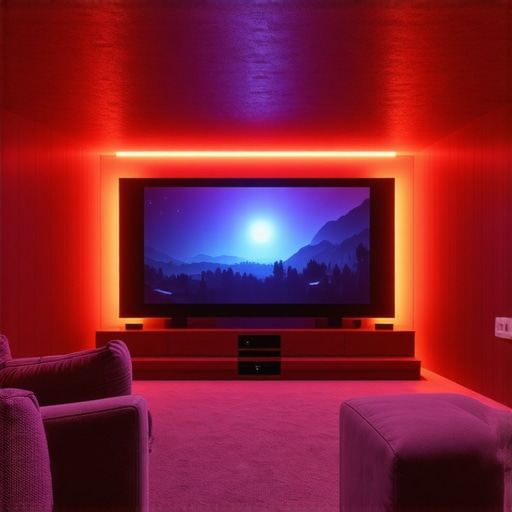
Seeing is believing: a high-resolution image showcasing a meticulously calibrated bias lighting setup with spectrum-tuning controls and ambient wall effects, illustrating the integration of science and aesthetic finesse in premium home theaters.
Integrating AI and Sensor Technologies for Adaptive Lighting Excellence
The frontier of bias lighting now intersects with artificial intelligence and sensor technology, promising a future where environments respond spontaneously to viewer actions and room conditions. By deploying smart sensors that monitor ambient luminance, color temperature, and even viewer gaze direction, integrated systems can automatically adjust wall bias lighting for optimal contrast and comfort. For instance, if the system detects increased ambient sunlight during daytime viewing, it can increase LED brightness or shift to cooler tones, preserving image clarity and reducing eye strain. AI algorithms, trained on extensive imaging datasets, can predict viewing patterns and preemptively modify lighting scenes, ensuring a consistently immersive experience without manual intervention. This convergence of technology exemplifies a new paradigm in home theater customization — where ambiance is not static but a living, intelligent entity designed to elevate your cinematic escapades at every moment.
What are the primary challenges in implementing AI-driven adaptive bias lighting systems, and how can they be addressed?
While offering remarkable potential, these systems face hurdles including sensor calibration accuracy, latency issues, and user privacy concerns. Calibration requires periodic validation to account for sensor drift and external environmental changes, which can be addressed through self-calibrating algorithms and user-friendly calibration routines. Latency in response times must be minimized to prevent perceptible delays that break immersion; high-refresh-rate sensors and edge computing solutions mitigate this challenge. Privacy considerations, paramount when collecting environmental data, demand transparent data handling practices and localized processing to ensure user confidence. Engaging 전문가와 협력하거나 문서화된 시스템 설계 지침을 따르는 것이 이러한 도전 과제를 극복하는 핵심 전략이다. Integrating these solutions ensures that AI-enhanced bias lighting remains both practical and respectful of user autonomy, setting a new standard for immersive home theater environments.
Harnessing Spectral Precision to Elevate Cinematic Depth
Beyond mere illumination, the nuanced application of spectral tuning in bias lighting transforms ambient environments into dynamic, perceptually immersive spaces. By integrating advanced tunable white LEDs and RGB systems, experienced practitioners manipulate spectral outputs to enhance contrast perception and reduce visual fatigue. This approach relies on a thorough understanding of colorimetric science, particularly the influence of spectral power distributions on human visual perception. Employing spectroradiometers allows for meticulous calibration, aligning ambient light with the on-screen luminance profile, thus preserving the medium’s cinematic integrity. This spectral harmony facilitates a seamless visual experience where the environment intrinsically complements the display, elevating the overall sensory engagement.
The Intersection of Architectural Integration and Light Diffusion Control
Architectural finesse plays a pivotal role in the efficacy of bias lighting setups. Expert designers consider wall surface textures, reflective properties, and fixture placement to optimize light diffusion and avoid hotspots. For instance, incorporating micro-foam diffusers or textured wall finishes can scatter light uniformly, fostering a wall-washing effect that accentuates wall depth without glare. Strategic placement of LED strips behind architectural features or within recessed niches capitalizes on room geometry, creating layered lighting effects that sculpt the space. Advanced modeling software, combined with photometric data, enables precise planning, ensuring that lighting not only accentuates design elements but also enhances functional comfort during extended viewing.
Can Adaptive Color Dynamics Influence Viewer Emotional Engagement?
Indeed, implementing adaptive color dynamics—through AI-driven control systems—allows the ambient lighting to respond intuitively to cinematic genres or narrative intensity. By leveraging real-time data on scene luminance and emotional tone, programmable bias lighting can shift from warm, cozy hues during intimate moments to cooler, invigorating tones during action sequences. This sophisticated approach aligns with neurovisual techniques aimed at enhancing emotional arousal and immersion. Integrating machine learning algorithms trained on cinematic content datasets enables predictive adjustments, creating an environment that synchronizes with the narrative arc, thus deepening viewer engagement and emotional resonance.
External Source: For an in-depth exploration of spectral effects on perception, refer to SPIE’s technical report on spectral engineering and visual perception.
Transformative Technologies Shaping Future Bias Lighting Solutions
The horizon of bias lighting innovation is bright, with emerging technologies promising unprecedented levels of customization and integration. Organic LEDs (OLEDs) offer ultra-thin, flexible panels that conform seamlessly to architectural features, delivering rich color profiles and high contrast ratios. Meanwhile, quantum dot-enhanced LEDs push the boundaries of spectral purity and luminous efficacy. The incorporation of nanomaterials facilitates advanced diffusion and light management, reducing glare and hotspots to near invisibility. Furthermore, the advent of AI-powered control interfaces enables intuitive scene-based adjustments, where lighting responds to voice commands or biometric data, tailoring ambiance to individual preferences with minimal user intervention. Staying ahead in this field requires continuous engagement with cutting-edge research and industry collaborations.
Advanced Integration Techniques for Seamless Home Theater Illumination
To achieve truly harmonious ambient lighting, specialists employ multi-zone control architectures coupled with sensor fusion, creating responsive environments that adapt seamlessly. Techniques such as spatially aware light mapping and real-time feedback systems minimize the risk of uneven lighting distribution, ensuring wall washing remains perfectly uniform. Employing low-latency communication protocols like Zigbee or Thread, alongside sophisticated luminance sensors, enables rapid adjustments aligned with content dynamics. Incorporating user profiles facilitates personalized presets, enhancing convenience without compromising artistic intent. Such integrations demand comprehensive planning and precise execution, often involving custom firmware development and industrial-grade hardware configurations to uphold reliability and aesthetic standards.
Community-Driven Innovations Lead to Tailored Sensory Experiences
Engaging with professional forums, industry consortiums, and academic publications fosters a culture of continuous innovation in bias lighting design. Collaborative efforts, including feedback loops from end-users and technical validation, drive the development of bespoke solutions that address niche requirements, from ultra-low glare setups for high-precision editing suites to artistically integrated lighting within historically styled interiors. Sharing case studies and experimental results accelerates knowledge dissemination, prompting the evolution of standards and best practices. Embracing this participatory approach allows enthusiasts and professionals alike to push the boundaries of what ambient lighting can achieve, effectively transforming subjective aesthetics into scientifically grounded, personalized experiences.
Elevate Your Setup with Precision Tactics
Strategic Calibration Enhances Immersion
Fine-tuning bias lighting through spectral and spatial calibration ensures a harmonious balance between ambient light and on-screen content, diminishing eye fatigue and enriching cinematic depth. Incorporating spectroradiometers and advanced diffusion materials, professionals achieve a seamless, glare-free environment that complements high-end displays.
Optimized Layering Provides Depth
Utilizing multi-zone, spatially aware lighting systems controlled via protocols like Zigbee enables nuanced scene setting. This layering of soft wall washing and accent lighting accentuates architectural elements while maintaining visual comfort, a hallmark of expert installations.
Adaptive Technologies Lead the Change
Integrating AI, sensor fusion, and spectral tuning creates intelligent environments that respond to ambient conditions and content dynamics. These innovations facilitate real-time adjustments, delivering an immersive experience tailored to viewer preferences and natural lighting variations.
Resources That Drive Expertise Forward
- Illuminating Engineering Society (IES): Offers comprehensive standards and research on lighting technologies and human-centric design principles.
- SPIE Digital Library: Features cutting-edge papers on spectral engineering and visual perception relevant to bias lighting optimization.
- Home Cinema Professionals Forums: A vibrant community sharing practical insights and innovative solutions for home theater lighting challenges.
Reflections for the Discerning Enthusiast
Mastering bias lighting in a home theater hinges on blending spectral accuracy, spatial control, and adaptive intelligence. Embracing these expert insights transforms standard setups into immersive, personalized environments that elevate cinematic experience. For those committed to excellence, engaging with authoritative resources and peer communities — like our detailed guides— not only informs but also inspires continuous innovation. Dive deeper, share your innovations, and help shape the future of home theater ambient lighting.

Leave a Reply