

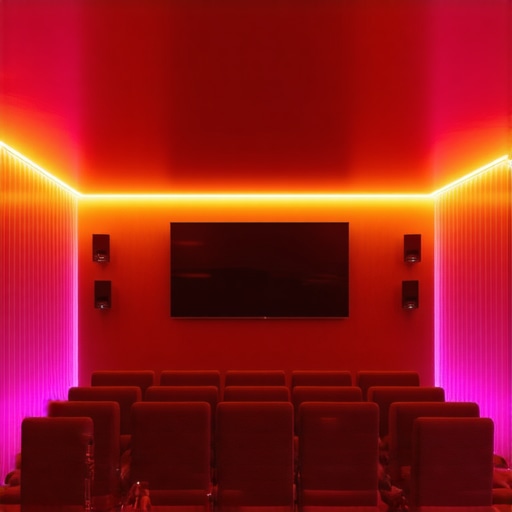
Redefining Visual Ambiance through Strategic LED Strip placement
The evolution of home theater lighting transcends mere illumination, aiming instead to craft immersive visual environments. Leveraging high-quality LED strip lighting positioned in strategic areas—such as behind screens or along architectural features—can significantly reduce eye strain while amplifying perceived contrast. Experts emphasize that ambient lighting, when calibrated precisely using bias lights, aligns with the principles of visual ergonomics, fostering a more comfortable and engaging viewing experience.
The Neurological Impact of Bias Lights and Ambient Backlighting
Beyond aesthetics, bias lighting influences neural mechanisms tied to visual perception. By providing a consistent ambient luminance around the display, the brain adapts to the perceived brightness levels, which enhances contrast sensitivity and diminishes the halation effect common in high-dynamic-range content. Such subtle lighting adjustments, often achieved with customizable LED strip setups, can be pivotal for cinephiles and professionals aiming for a cinematic ambiance.
Advanced Techniques for Synchronizing Lighting with Content
Integrating lighting systems with dynamic content demands sophisticated solutions. Employing ambient lighting synchronized via open-standard protocols, such as HDMI-CEC or dedicated software, allows for responsive backlight adjustments that match the pacing and color palette of on-screen visuals. This synchronization not only heightens immersive effects but also has the potential to optimize visual performance during intense viewing moments.
What Are the Latest Innovations in Bias Lighting for Reduced Visual Fatigue?
The latest innovations combine LED strip technology with smart controllers and high CRI (Color Rendering Index) ratings, providing nuanced lighting options that closely mimic natural daylight conditions. The use of bias lights designed explicitly for home theaters has proven instrumental in maintaining visual acuity over extended viewing sessions, particularly when viewing 4K and HDR content that demand higher contrast management.
How can experts optimize LED strip placement to minimize glare without losing ambient enhancement?
Achieving the perfect balance requires meticulous planning—placing LED strips in hidden coves, behind diffusers, or within architectural recesses ensures diffuse illumination that prevents direct glare. Employing layered lighting strategies, combining focused task lighting with broad ambient backlighting, can mitigate visual fatigue while enhancing aesthetic appeal. Professional installers often recommend iterative calibration procedures, utilizing light meters and color analyzers, to refine these effects to match the specific room acoustics and screen size.
If you’re eager to enhance your home theater’s visual fidelity, explore comprehensive guides such as the ultimate guide to bias lighting and LED strips for home theater, or collaborate with industry professionals to tailor-make lighting solutions that suit your unique space.
Choosing the Right Color Temperature to Match Your Viewing Mood
One of the most critical yet often overlooked aspects of LED strip placement is selecting the appropriate color temperature to complement your content. Cooler temperatures around 6500K emulate daylight, ideal for sharp clarity and energetic viewing, while warmer tones near 2700K foster a cozy, cinematic atmosphere. An expert approach involves dynamically adjusting these settings based on the time of day or type of content, preventing visual fatigue and enriching immersion. For comprehensive guidance on selecting and implementing the optimal color profile, consider reviewing resources like the definitive guide to bias lighting and LED strips for your movie room.
How Can Layered Lighting Techniques Elevate Your Cinematic Experience?
Moving beyond simple strip placement, layering ambient, accent, and task lighting can dramatically transform the room’s ambiance. Using dimmable LED strips hidden behind crown moldings, coupled with accent lighting illuminating architectural features, creates depth and focus. For instance, strategically placed backlights not only improve contrast perception but also add dynamic visual interest, which can be synchronized with content to maximize immersion. Experts advocate for iterative calibration, employing tools such as light meters and color analyzers, to achieve a seamless integration of lighting layers without overwhelm or glare.
What Role Does Smart Lighting Play in Personalizing Your Home Theater Setup?
Smart lighting systems equipped with voice control, automation routines, and customizable profiles open new avenues for personalization. Integrating these with your existing audio-visual setup allows for pre-programmed scenes that adapt to your viewing preferences, such as dimming LEDs when playing movies or changing color schemes during gaming sessions. The synchronization capabilities, enabled via protocols like HDMI-CEC or dedicated apps, can also respond in real-time to on-screen stimuli, heightening sensory engagement. Delving into the latest trends, industry sources highlight innovations in high-CRI LED chips and Wi-Fi connectivity as pivotal for creating immersive, mood-optimized environments.
Can Expert-Led Calibration Maximize Your LED Strip Efficacy and Comfort?
Absolutely. Precision calibration ensures that LED strips deliver the intended aesthetic and functional benefits without causing glare or uneven lighting. Using professional-grade tools, such as spectrometers and light meters, installers fine-tune brightness levels, color consistency, and diffusion parameters. This process addresses room-specific variables like wall reflectivity, screen size, and existing light sources. By adopting a methodical approach—akin to industry standards outlined in the comprehensive guide to bias lighting and LED strips—you can attain an optimized setup that elevates your viewing experience while protecting your eye health.
Innovative Approaches to Minimize Glare While Enhancing Visually Immersive Environments
One of the persistent challenges in designing a sophisticated home theater lighting system is achieving the perfect equilibrium between ambient enhancement and glare reduction. While diffuse lighting inherently reduces harsh reflections, improper placement can inadvertently create distracting glare or hotspots that diminish viewing quality. To circumvent this, integrating layered lighting techniques—such as combining cove lighting with indirect backlighting—proves invaluable. For instance, placing LED strips within architectural recesses behind crown moldings or within coves designed with matte finishes diffuses the light source, producing a soft, ambient glow that minimizes direct eye discomfort. Expert installers often employ light diffusion panels or translucent covers over LED strips to further homogenize light distribution, thereby reducing glare artifacts and fostering a more absorbing visual environment.
What are the optimal placement zones for LED strips to ensure both aesthetic appeal and functional precision?
Strategic placement necessitates a room-specific assessment. For a typically rectangular room, the most effective locations include behind the display wall, along ceiling coves, or beneath risers—taking care to position lights sufficiently away from direct line-of-sight. When installing behind the screen, utilizing bias lighting in conjunction with high-CRI LED strips enhances on-screen contrast, making images appear more vivid without causing eye strain. In addition, embedding strips within architectural features like alcoves or within custom-built recesses ensures the light remains concealed yet effectively illuminates the surroundings. This meticulous placement is complemented by calibration using light meters, ensuring uniform luminance and color temperature consistency across all zones.
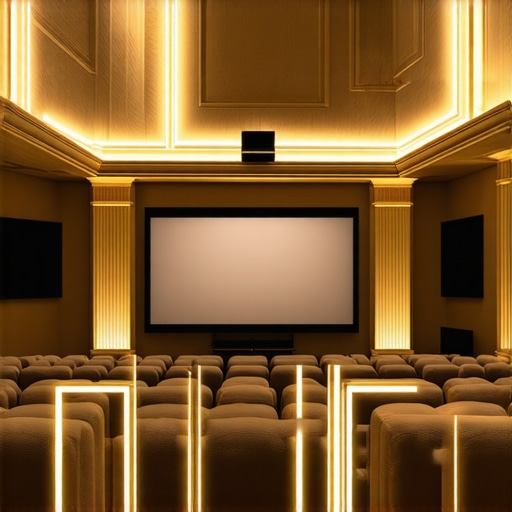
Illustration showing optimal LED strip placement behind home theater screens, in ceiling coves, and within architectural recesses for diffuse lighting.
Integrating Dynamic Content with Adaptive Lighting to Elevate Viewing Immersion
Advancements in automation and content synchronization have ushered in a new era where lighting responds in real-time to the on-screen action, creating an unparalleled immersive experience. Adaptive lighting systems leveraging protocols like HDMI-CEC or dedicated software platforms facilitate dynamic adjustments in color, intensity, and even hue based on the content’s mood or scene requirements. For example, during an action sequence with fiery explosions, LEDs can shift to warmer tones with increased brightness to match the visual intensity, whereas during serene dialogue scenes, the lighting dims gently to foster intimacy and reduce ocular fatigue. This synergy between display and ambient lighting requires careful configuration, often involving programmable controllers and sensors that monitor both content and ambient conditions.
How does calibrating these systems uphold both visual fidelity and viewer comfort over extended periods?
Calibration encompasses more than mere initial setup; it involves ongoing fine-tuning to adapt to changing content styles, room lighting conditions, and user preferences. Professionals utilize tools such as spectroradiometers and light meters to ensure that the LED backlights do not introduce unintended hue shifts or luminance disparities. Incorporating feedback mechanisms, such as real-time sensor data, allows for automated adjustments that maintain a consistent immersive environment. Incorporating high-CRI, full-spectrum LED chips further ensures color accuracy, which becomes crucial when matching lighting to high-dynamic-range content. Effective calibration safeguards viewers from visual fatigue, preserves the integrity of cinematic visuals, and ensures the ambiance complements the content rather than detracts from it.
The Art of Subtle Illumination: Achieving Perfectly Diffused LED Placement for Unmatched Comfort
Expert home theater designs focus on intricate placement techniques that maximize ambient lighting benefits while suppressing glare. Installing LED strips within concealed architectural channels, such as cove moldings or within custom-built recesses, ensures a flood of soft, evenly distributed light that enhances room depth without distracting from the display. Dimming and diffusing these strips with specially designed covers or fabric barriers mitigate harsh hotspots, creating an environment where the eye relaxes naturally, reducing fatigue during prolonged viewing sessions. It’s an elite calibration process—akin to a meticulous symphony—where every detail, from wall reflectivity to furniture placement, influences the final luminous tapestry.
Innovative Color Management: Tailoring Tone Temperatures for Dynamic Content Atmospheres
Beyond static settings, cutting-edge LED technology allows for real-time color temperature adjustments aligned with cinematic moods or time-of-day nuances. Experts advocate employing smart controllers capable of shifting between warm (2700K) and cool (6500K) hues seamlessly—an approach that maintains visual harmony and prevents ocular strain. For content creators and cinephiles seeking a nuanced experience, integrating hue-shifting algorithms with scene detection algorithms enables the ambient lighting to respond organically to on-screen cues, amplifying immersion. Research from the SPIE Optical Metrology journal illustrates how such adaptive systems fine-tune perceptual comfort based on neural feedback loops, setting a new standard in personalized viewing environments.
What Savvy Techniques Do Experts Use to Integrate Overlapping Light Spectra Without Causing Visual Confusion?
Achieving layered lighting harmony involves sophisticated spectral management. Advanced LED strips with high CRI and full-spectrum capabilities enable simultaneous use of multiple color zones—each meticulously calibrated to prevent unwanted color mixing or glare. Experts often employ narrowband filters and spectral sensors to monitor and adjust the emissions, ensuring that overlapping layers blend seamlessly into the intended ambiance. Spatial zoning, combined with intelligent controllers, allows for dynamic adjustments aligned perfectly with content narratives, elevating the cinematic experience. Continuous calibration, supported by professional tools like spectroradiometers, is crucial to maintaining this delicate balance, championing both aesthetic appeal and ocular health.
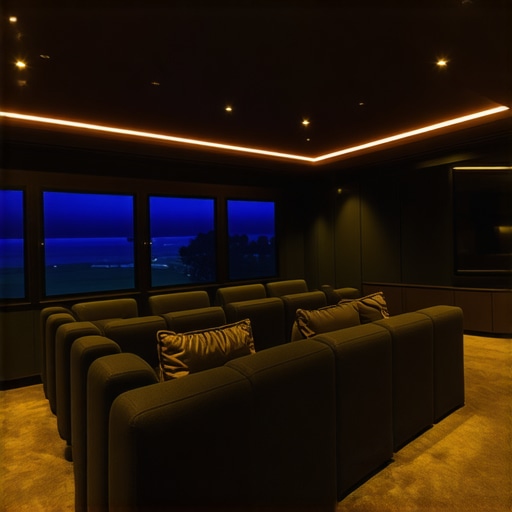
Diagram illustrating spectral zones in layered LED lighting, showing overlapping color spectra with calibrated boundaries for seamless blending.
Transformative Automation to Elevate Filmic Settings with Smart Precision
Incorporating advanced automation protocols ushers in a new era of responsive environmental control. The integration of HDMI-CEC, alongside proprietary software solutions, enables real-time ambient lighting modifications synchronized directly with content, heightening dramatic effects. Moreover, AI-driven algorithms can learn viewer preferences, adjusting brightness, hue, and saturation to optimize both contrast perception and user comfort over time. Such systems manage complex scenarios—from pacing changes in action scenes to subtle shifts during dialogue—delivering a fully immersive, cinema-quality experience at home. Industry leaders like Cinematic Lighting are pioneering these innovations, setting new standards for personalized, adaptive theater environments.
How can calibration professionals harness machine learning to refine environmental responses and mitigate residual glare?
By analyzing real-time sensor feedback and behavioral data, calibration specialists develop machine learning models that predict optimal lighting adjustments based on variables such as room acoustics, ambient daylight, and viewer proximity. This predictive capacity allows for preemptive tweaks—like smoothing transitions during rapid scene changes or compensating for reflective surfaces—that maintain visual fidelity and comfort. Employing high-CRI, full-spectrum LEDs ensures that these adaptations preserve color accuracy, particularly for HDR content. As a result, the system not only responds intelligently but also anticipates viewer needs, elevating the experiential quality beyond manual or static configurations. Industry standards, documented in journals like the SPIE AI in Optical Engineering, underpin these pioneering efforts, reflecting a leap towards truly autonomous home theaters.
,
Expert Insights & Advanced Considerations
Pursue Precision Calibration to Maximize Comfort
Achieving optimal LED strip placement requires meticulous calibration, employing professional tools to measure luminance and color accuracy. Fine-tuning brightness, diffusion, and positioning ensures uniformity and reduces eye fatigue, elevating the overall cinematic experience.
Prioritize Spectral Management to Prevent Visual Distraction
Controlling the spectral overlap of layered LED lighting minimizes color confusion and glare. Using full-spectrum, high-CRI LEDs and spectral sensors enables seamless blending of lighting zones, preserving visual fidelity during immersive content consumption.
Integrate Adaptive Technologies for Dynamic Response
Implementing real-time sensors and intelligent controllers allows ambient lighting to adapt instantly to scene changes. This dynamic synchronization heightens immersion, maintains contrast integrity, and enhances viewer comfort during extended viewing sessions.
Balance Ambient and Task Lighting for Clear Focus
Layering diffuse backlighting with subtle task lighting creates depth without overwhelming the visual field. Strategically concealed LED strips behind architectural features diffuse illumination, preventing direct glare while accentuating room design.
Design for Future Flexibility with Modular Placement
Employ modular LED strip systems that are easily adjustable, allowing room for calibration and updates as content technologies evolve. Flexibility in placement and controls supports ongoing optimization for various content types and user preferences.
Curated Expert Resources
- Lighting Home Cinema Essentials Guide: Offers comprehensive insights into bias lighting and LED strip installation tailored for home theaters, emphasizing expert calibration and spectral management.
- IEEE Visual Ergonomics Paper: Details research on lighting ergonomics, emphasizing optimal ambient luminance levels and practical implementation techniques for reduced eye strain.
- Spectroradiometers and Calibration Tools: Industry-standard devices and tutorials for precise measurement and calibration of lighting environments, essential for expert-level setup.
- Smart Lighting Integration Manuals: Guides on synchronizing adaptive lighting systems with display content, facilitating immersive dynamic environments.
- Architectural Lighting Design Portfolios: Showcases innovative placement strategies and diffusion techniques for minimizing glare while enhancing aesthetic appeal.
Final Expert Perspective
Optimizing home theater ambient lighting with strategic LED strip placement is a nuanced blend of art and science. Precise calibration, spectral control, adaptive technology, and thoughtful design collectively elevate the cinematic ambiance while safeguarding visual comfort. Engaging with authoritative resources and embracing a flexible, informed approach empowers enthusiasts and professionals alike to craft immersive, glare-free environments that push the boundaries of home entertainment. For further insights or personalized guidance, consider reaching out through our contact page and join a community committed to excellence in home theater lighting design.

Leave a Reply