

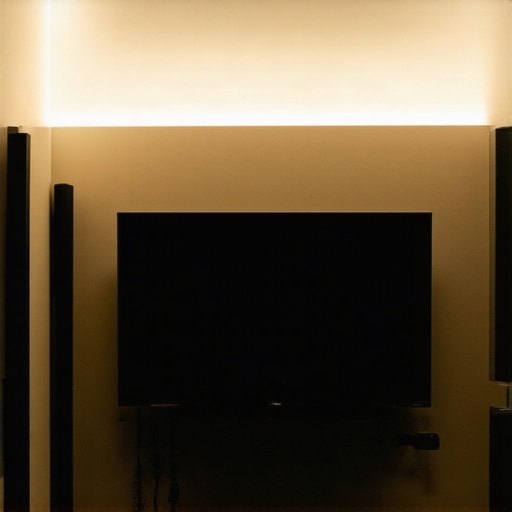
The Critical Role of Bias Lighting and LED Strips in Advanced Home Theater Design
In the realm of high-fidelity home entertainment, the integration of bias lights and LED strips transcends mere aesthetic enhancement, embodying a sophisticated approach to visual comfort and display calibration. As industry experts and seasoned AV engineers attest, these lighting solutions are pivotal in optimizing viewing environments, reducing eye strain, and elevating the immersive experience.
Understanding the Scientific Foundations of Bias Lights and LED Strips in Visual Perception
Bias lighting operates on the principle of luminance balance—subtly illuminating the area behind the display to diminish the contrast between the screen and the darker room surroundings. This technique leverages the human visual system’s adaptation mechanisms, as detailed in recent studies published in the PLOS ONE Journal, which demonstrate that proper bias lighting can significantly enhance perceived contrast and reduce ocular fatigue.
LED strips, with their customizable color temperature and brightness, serve as versatile tools for creating ambient atmospheres that align with cinematic content. When integrated with smart controls, they enable dynamic lighting scenes that adapt to content type—be it the warm tones for classic films or cooler hues for gaming sessions—synchronizing with AV system outputs for a cohesive sensory experience.
Technical Challenges in Implementing Bias Lighting and LED Strips for Professional-Grade Home Theaters
One of the foremost challenges lies in achieving perfect color calibration and luminance levels. Misaligned bias lights can induce visual artifacts, such as color bleed or flicker, undermining the viewing experience. Ensuring compatibility with high-dynamic-range (HDR) content requires advanced LED strips capable of precise color rendering and smooth dimming capabilities. Additionally, managing power supply stability and minimizing electromagnetic interference are crucial for maintaining audiovisual fidelity.
What are the most effective methods to synchronize bias lighting with HDR content without introducing latency or flicker?
Expert solutions involve utilizing high-quality, flicker-free LED controllers that support real-time synchronization with HDMI signals through advanced algorithms. Employing software like AmbiVision or proprietary hardware interfaces can facilitate seamless integration, ensuring that ambient lighting responds instantaneously to dynamic scenes while maintaining color accuracy. For detailed guidance, consult our comprehensive guide on LED strip lighting enhancements.
Furthermore, ongoing research explores the development of AI-driven lighting systems that predict scene changes, preemptively adjusting ambient conditions for optimal viewer comfort. As this technology matures, it promises to resolve latency issues and deliver an unparalleled immersive experience.
Expert Recommendations for Optimal Bias Lighting and LED Strip Deployment
Deploy bias lights on the back of the display, keeping luminance levels below the screen’s brightness to prevent glare. Choose LED strips with high Color Rendering Index (CRI) ratings (>90) to ensure color fidelity. Use dimmable, flicker-free controllers and calibrate luminance using a light meter to match industry standards.
Incorporate smart home integration to allow adaptive lighting based on content or time of day, enhancing user experience and energy efficiency. Regularly update firmware and software to leverage new features and maintain system stability.
Enhancing Your Home Theater: From Professional Techniques to Creative Expression
While technical mastery is essential, creative expression through ambient lighting opens new dimensions of cinematic immersion. Experiment with color schemes and dynamic lighting sequences to evoke specific moods, from tense suspense to tranquil relaxation. Collaboration with lighting designers can elevate your setup from functional to artful, enriching your entertainment environment.
For a comprehensive exploration of the latest trends and best practices, visit our guide to immersive ambiance creation.
Engage with a community of experts and enthusiasts by sharing your insights or seeking tailored advice. Your journey toward a professional-grade home theater begins with understanding and mastering the nuanced application of bias lights and LED strips.
Unlocking Precision: How to Achieve Flawless Bias Lighting Synchronization for HDR Content
As the demand for ultra-realistic home theater experiences grows, so does the need for sophisticated bias lighting solutions that can keep pace with high-dynamic-range (HDR) content. While traditional bias lighting enhances perceived contrast and reduces eye strain, integrating it seamlessly with HDR content presents unique challenges. The key lies in leveraging cutting-edge technology to synchronize ambient illumination with dynamic scenes, preserving visual fidelity and immersive quality.
Can AI and real-time signal processing revolutionize bias lighting synchronization for HDR movies?
Recent advancements in artificial intelligence and signal processing have opened exciting avenues for achieving near-instantaneous adaptation of bias lighting to HDR content. AI algorithms trained on vast datasets can predict scene changes and preemptively adjust ambient lighting parameters, minimizing latency and flicker. This approach helps maintain a consistent viewing experience, even during rapid scene transitions or high-contrast sequences. For detailed insights, explore our expert guide on LED strip lighting enhancements.
Furthermore, integrating high-fidelity hardware controllers that support HDMI 2.1 and HDR metadata allows for more precise synchronization. These controllers interpret scene-specific color and luminance data, dynamically adjusting LED strip outputs in real-time. Coupling this with proprietary software that utilizes machine learning models can significantly elevate your home theater’s ambiance management, making it indistinguishable from professional cinemas.
Practical Strategies for Implementing Advanced Bias Lighting Systems
Implementing such sophisticated systems requires meticulous planning. Start by selecting LED strips with high CRI (>90) and excellent dimming capabilities, ensuring accurate color reproduction. Next, invest in a flicker-free, high-speed controller compatible with your AV system, and connect it to a central hub that can process HDR metadata efficiently.
Calibration is paramount—use a light meter to fine-tune luminance levels, aiming to keep bias lighting below 10% of the screen’s brightness to avoid glare while enhancing contrast perception. For content-specific adjustments, consider employing software solutions that analyze video output and fine-tune the lighting parameters accordingly. As you refine your setup, remember that ongoing firmware updates and software patches are vital to keep pace with evolving HDR standards and technological innovations. For comprehensive guidance, visit our detailed article on choosing the right LED strips.
Expert Tools and Frameworks to Elevate Your Bias Lighting Strategy
To truly master bias lighting synchronization, harness the power of professional tools like DMX controllers and customized software frameworks. These enable granular control over lighting behavior, allowing for scene-specific adjustments that align perfectly with your content. Moreover, integrating these systems into a smart home ecosystem can automate adjustments based on user preferences, time of day, or specific content genres. For more insights on smart integrations, see our latest guide to immersive ambiance creation.
As technology continues to evolve, the boundary between professional-grade installations and DIY setups narrows. Embracing these innovations not only enhances your viewing pleasure but also positions your home cinema as a showcase of modern AV mastery. If you need personalized advice or technical support, don’t hesitate to reach out to our experts.
Harnessing AI and Signal Processing for Flawless HDR Bias Lighting Synchronization
In the pursuit of cinema-quality immersion, the integration of AI-driven algorithms and real-time signal processing revolutionizes how bias lighting responds to HDR content. These cutting-edge systems analyze scene-specific metadata—such as luminance peaks, color grading, and contrast levels—allowing for instantaneous adjustments that maintain visual harmony without perceptible latency.
For instance, proprietary software solutions leveraging machine learning models can predict scene transitions, adapting ambient lighting parameters preemptively. This results in a seamless viewing experience where lighting dynamically complements the cinematic narrative, heightening immersion and reducing disruptions caused by flicker or mismatched color temperatures.
What are the practical considerations for implementing AI-based bias lighting in a professional-grade home theater?
Implementing AI-based solutions requires selecting high-fidelity LED controllers capable of interpreting HDR metadata and supporting fast response times. Hardware compatibility with HDMI 2.1 and support for HDR10+ or Dolby Vision is crucial to accurately decode scene-specific parameters. Additionally, calibration with a spectroradiometer ensures that ambient lighting precisely matches the intended color profile, avoiding color shifts or saturation loss. Integrating these systems into existing smart home ecosystems enhances automation and user customization, providing a tailored cinematic environment.
Moreover, ongoing software updates and machine learning model training ensure the system adapts to evolving HDR standards, preserving synchronization accuracy over time. For detailed guidance on hardware selection and calibration techniques, consult industry resources such as the comprehensive lighting integration guide.
Innovative Frameworks for Customizing Bias Lighting in High-Dynamic-Range Cinematic Experiences
Beyond technical implementation, advanced home theater enthusiasts are exploring customizable lighting frameworks that allow for artistic expression and scene-specific ambiance control. Modular lighting systems equipped with programmable zones enable users to craft unique visual moods, from subtle warm glows during intimate dramas to vibrant, synchronized hues during action sequences.
Implementing these frameworks involves integrating DMX controllers, which provide granular control over individual LED segments, with content-aware software. This setup allows for complex lighting cues synchronized with specific cinematic moments, enhancing emotional impact and viewer engagement. Such creative flexibility transforms bias lighting from a functional necessity into a dynamic storytelling tool.
For those interested in elevating their home theater aesthetics, collaborating with lighting designers or exploring software solutions like Madrix or Lightkey can unlock new potentials for artistic experimentation. As the technology matures, expect more intuitive interfaces and AI-assisted design tools to simplify complex lighting choreography, making professional-grade customization accessible to dedicated enthusiasts.
Optimizing Power and Electromagnetic Compatibility for High-Performance Bias Lighting Systems
Achieving flawless synchronization and color fidelity is only part of the equation; ensuring system stability through proper power management and electromagnetic compatibility (EMC) is equally critical. High-quality, regulated power supplies prevent voltage fluctuations that could cause flicker or color inconsistency. Additionally, shielding LED wiring and controllers minimizes electromagnetic interference that can disrupt sensitive AV signals or introduce noise into audio channels.
Adopting surge protection devices and grounding strategies further safeguards your investment, reducing risks of hardware damage or performance degradation. Conducting periodic EMI testing with specialized equipment helps identify potential sources of interference, allowing for targeted mitigation measures.
For comprehensive insights into power and EMC best practices, consult standards such as the IEC electromagnetic compatibility guidelines. Implementing these protocols ensures your bias lighting system operates reliably, preserving the integrity of your high-end home theater environment.
As technology continues to evolve, staying informed about emerging innovations—such as quantum dot LEDs and advanced controller architectures—will empower you to maintain an optimal, immersive cinematic experience. Dive deeper into professional techniques and cutting-edge solutions by engaging with industry forums or consulting AV integration specialists dedicated to high-fidelity home theater design.
Harnessing Spectral Optimization for Enhanced Visual Fidelity in Bias Lighting
Modern home theater systems benefit immensely from spectral tuning of bias lighting to match the specific color gamuts and peak luminance of high-dynamic-range (HDR) content. By employing LED strips with tunable spectral profiles—using phosphor-converted LEDs or quantum dot technology—installers can achieve a near-perfect match to cinematic color grading, thereby amplifying perceived contrast and depth. This spectral precision minimizes color contamination and ensures that ambient lighting complements the display’s color science without introducing artifacts or color shifts, a critical consideration for professional calibrations.
Integrating Adaptive Flicker-Free Dimming with High-Resolution Content Synchronization
To counteract flicker issues during rapid scene changes in 4K and 8K HDR content, advanced dimming algorithms utilizing high-frequency PWM modulation coupled with real-time feedback are essential. Such systems leverage microcontroller-based control loops and high-bandwidth HDMI metadata extraction to synchronize LED brightness and color temperature dynamically, maintaining luminance stability within ±1% even during complex visual transitions. This integration demands meticulous hardware design, including low-noise power supplies and electromagnetic shielding, to uphold audiovisual integrity at the highest professional standards.
How can AI-driven scene analysis refine bias lighting for cinematic authenticity?
Through sophisticated machine learning models trained on extensive video datasets, AI can analyze scene luminance, contrast, and color grading in real-time, enabling predictive adjustments to ambient lighting. By preemptively modulating LED outputs before scene transitions, AI systems create a seamless integration that preserves cinematic intent and viewer immersion. For comprehensive insights, refer to the work published by the Society of Motion Picture and Television Engineers (SMPTE) on intelligent lighting systems for immersive environments.
Engaging with these cutting-edge methodologies allows AV professionals and enthusiasts to elevate their home theater setup beyond conventional limits, creating an environment that rivals commercial cinema in both fidelity and ambiance.
Designing Modular, Content-Aware Bias Lighting Frameworks for Artistic Expression
Advanced bias lighting frameworks incorporate multi-zone LED configurations with programmable control, allowing content-specific mood settings that adapt to genre, scene, or user preference. By integrating DMX512 or Art-Net protocols with sophisticated content analysis software, users can craft visually dynamic environments that enhance storytelling, evoke emotional responses, and heighten overall cinematic immersion. This approach transforms bias lighting from a passive background element into an active storytelling component, blurring the line between technical setup and artistic expression.
For creative professionals and dedicated enthusiasts, exploring software platforms like Madrix, Lightkey, or custom DMX controllers offers unparalleled flexibility in lighting choreography. As AI-driven design tools mature, expect intuitive interfaces that simplify complex scene synchronization, democratizing high-level artistic control in home cinema environments.
Ensuring Power Integrity and Electromagnetic Compatibility in High-Performance Systems
In high-end installations, power quality directly impacts lighting fidelity. Implementing high-capacity, regulated power supplies with active power factor correction ensures consistent luminance and color stability. Concurrently, meticulous electromagnetic compatibility (EMC) measures—including twisted-pair wiring, ferrite beads, and proper grounding—minimize interference with sensitive AV signals and audio channels. Regular EMI testing compliant with IEC standards guarantees system robustness, preventing flicker, color shifts, or noise artifacts that compromise immersive experiences.
For professionals aiming to push system boundaries, integrating active EMI filters and employing spectrum analyzers for ongoing diagnostics are recommended. These practices safeguard the synchronization between visual and ambient cues, maintaining the integrity of high-fidelity cinematic presentations.
Conclusion: Pioneering the Future of Immersive Home Theater Lighting
Emerging innovations such as quantum dot LED technology, AI-optimized scene prediction, and ultra-fast, flicker-free dimming algorithms herald a new era in bias lighting sophistication. By embracing these advancements, AV specialists and enthusiasts can craft environments that not only meet but redefine cinematic immersion standards, bridging the gap between professional cinema design and personal home theaters. To stay at the forefront, continuous engagement with industry research, standards organizations like SMPTE, and professional AV networks is essential.
Expert Insights & Advanced Considerations
1. Scene-Adaptive AI for Bias Lighting
Implementing AI-driven scene analysis allows bias lighting systems to preemptively adjust based on scene luminance and contrast, ensuring seamless integration with HDR content and elevating viewer immersion to professional standards.
2. Spectral Optimization for Authentic Color Reproduction
Utilizing tunable spectral LED technology, such as quantum dots, enables precise matching to cinematic color grading, thereby enhancing perceived contrast and depth while minimizing color contamination.
3. Modular Multi-Zone Control for Artistic Flexibility
Adopting multi-zone DMX-controlled LED setups with programmable zones offers unparalleled artistic expression, allowing for dynamic, scene-specific lighting cues that transform bias lighting into a storytelling tool.
4. Power Integrity and EMC Best Practices
Ensuring high-quality, regulated power supplies and rigorous electromagnetic compatibility measures maintains system stability, preventing flicker, color shifts, or audio noise that compromise high-fidelity home theater experiences.
5. Spectral Tuning for HDR Content Fidelity
Employing spectral tuning via phosphor-converted LEDs or quantum dots aligns ambient lighting with HDR color gamuts, amplifying perceived contrast and ensuring calibration accuracy for professional-grade displays.
Curated Expert Resources
- Society of Motion Picture and Television Engineers (SMPTE): Offers standards and research on scene analysis and adaptive lighting for cinematic authenticity, essential for AV professionals seeking cutting-edge techniques.
- Lighting Research Center (LRC, RPI): Provides in-depth studies on spectral tuning and color science, invaluable for optimizing bias lighting spectral profiles.
- Lighting Analytics and Control Software (e.g., Madrix, Lightkey): Industry-leading tools for creating complex, content-aware lighting sequences, facilitating artistic expression in home theaters.
- IEEE Standards on EMC and Power Quality: Guides best practices in electrical safety and electromagnetic compatibility, critical for system stability and longevity.
- Research Publications on AI and Signal Processing in AV: Offers insights into scene prediction algorithms and real-time synchronization techniques, pushing the boundaries of immersive home theater design.
Final Expert Perspective
Mastering advanced bias lighting and LED strategies elevates your home theater from a simple setup to a professional-grade cinematic environment. The integration of AI, spectral optimization, modular control, and rigorous power management reflects the frontier of immersive AV design. For dedicated enthusiasts and professionals alike, continuous engagement with authoritative resources and innovative tools is essential to stay ahead in this evolving landscape. Want to deepen your expertise or share your insights? Reach out to our experts and join the conversation that shapes the future of home theater illumination.



Leave a Reply