

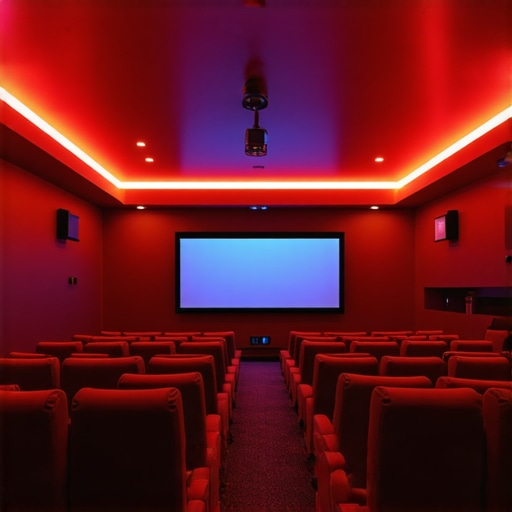
Mastering the Art of Ambient Lighting for a Cinematic Home Theater
Creating an immersive home theater environment transcends mere screen size and sound quality; the strategic deployment of bias lights, LED strips, and ambient lighting plays a pivotal role in reducing eye strain, enhancing contrast, and elevating overall viewing comfort. As an expert in home cinema illumination, I emphasize that sophisticated lighting solutions are integral to achieving a professional-grade ambiance that rivals commercial theaters.
Designing a Cohesive Lighting Ecosystem Using Bias Lights and LED Strips
Implementing bias lighting involves more than just installing LED strips behind the display. It requires careful consideration of color temperature, placement, and synchronization with content to prevent glare and ensure visual harmony. Modern LED strip options, such as RGB and tunable white variants, offer unparalleled flexibility for customizing mood settings, whether for intense action sequences or relaxing weekend movie marathons. For optimal results, consult detailed guides like Ultimate Guide to Bias Lighting & LED Strips for Home Theater in 2024.
Optimizing Light Placement for Visual Comfort and Atmosphere
Proper installation is crucial. LED strips should be positioned to create a diffuse glow that prevents eye fatigue while enhancing perceived contrast. Experts recommend indirect lighting strategies, such as placing strips along the back edges of cabinetry or ceiling coves, which produce a soft, ambient glow. This technique not only minimizes reflections on the screen but also elevates the aesthetic appeal, transforming the room into a cinematic sanctuary. For inspiration on innovative placement, explore top LED strip backlight ideas for 2024.
Balancing Color Temperature and Brightness for a Natural Viewing Experience
Color temperature alignment between bias lights and room lighting is vital. Cooler tones (6500K) mimic daylight and are suitable for focus-intensive tasks, while warmer hues (3000K) foster relaxation. Adjustable LED strips empower users to fine-tune lighting conditions, which can be synchronized via smart home systems for dynamic scene changes. This nuanced control ensures that ambient lighting complements the content, reducing visual fatigue and enhancing immersion.
How Can Advanced Ambient Lighting Techniques Transform Viewer Engagement?
Expert discussions reveal that dynamic ambient lighting not only enhances aesthetic appeal but also influences emotional responses and viewer engagement. By employing programmable LED strips and bias lights synchronized with on-screen content, you can craft a truly immersive experience. Moreover, integrating ambient lighting with soundproofing and acoustic treatments further elevates the cinematic atmosphere, making it a holistic sensory environment.
What are the latest innovations in LED strip technology that can further improve home theater ambiance?
Innovations such as addressable RGB LED strips, nano-coating for durability, and integration with voice control platforms are redefining home cinema lighting. These advancements allow for more precise and customizable lighting schemes, enabling users to tailor their environments with cinematic precision. Staying updated with industry trends through expert sources like Lighting Home Cinema Essentials can provide invaluable insights.
If you are passionate about perfecting your home theater ambiance, consider exploring professional lighting consultancy or engaging with fellow enthusiasts through dedicated forums. Your expertise and feedback can contribute to a richer, more innovative lighting design community.
Unlocking Next-Gen LED Strip Technologies for Cinematic Brilliance
As the home theater landscape evolves, so do the lighting solutions that define ambiance and immersion. Recent breakthroughs, such as ultra-high-density addressable RGB LED strips and nano-coating for enhanced durability, are transforming how enthusiasts craft their environments. These innovations enable intricate lighting patterns, dynamic color transitions, and longer-lasting setups, ensuring your cinematic space remains stunning and reliable over time. For a comprehensive understanding of the latest advancements, consult Expert Guide to Bias Lighting & LED Strips in 2024.
How Can Customization and Smart Integration Redefine User Experience?
Modern LED strips now support seamless integration with smart home ecosystems, allowing users to synchronize lighting with content, sound, and even voice commands. This level of customization turns static lighting into an interactive element that adapts to your viewing habits, mood, and preferences. Programmable features like scene recall, color temperature adjustment, and even reactive lighting that responds to on-screen action elevate the immersive quality of your setup. To optimize placement and functionality, explore installation tips for ambient LED lighting.
Can AI and automation push home theater lighting to a new level of sophistication?
AI-driven lighting systems are increasingly capable of learning user preferences and adjusting in real-time for maximum comfort and aesthetic appeal. These systems can analyze ambient conditions, content type, and even viewer responses to automatically fine-tune brightness, color, and patterns. This intelligent approach minimizes manual adjustments and ensures an optimal viewing environment that adapts to every scene. Industry experts like Lighting Home Cinema Essentials highlight that integrating AI with LED lighting is the future of personalized home cinema experiences.
To further refine your setup, consider exploring community forums and professional consultation, which can provide tailored advice and creative ideas for integrating these technologies seamlessly into your space.
Next-Level Lighting Control for Custom Home Cinema Environments
As technology advances, so does our capacity to craft highly personalized and responsive lighting ecosystems within home theaters. The integration of sophisticated smart systems, such as DMX512 and Art-Net protocols, enables precise control over multiple lighting zones, creating dynamic scenes tailored to specific content genres or user moods. These protocols facilitate real-time adjustments, color transitions, and synchronized effects that elevate the cinematic experience beyond traditional static illumination.
For instance, professional-grade setups leverage software like Lightjams or Madrix, which allow for intricate programming of lighting sequences that respond to audio cues, on-screen action, or user commands. This level of customization ensures that your ambient lighting not only complements the visual content but actively enhances emotional engagement, making every viewing session uniquely immersive.
Harnessing the Power of Tunable White and Full RGB LED Strips
While RGB LED strips provide vibrant color options, the advent of tunable white LEDs introduces a new dimension of naturalistic lighting. These strips can seamlessly transition between warm and cool tones, mimicking the changing ambient conditions of a real-world environment. When combined with full RGB capabilities, they offer a comprehensive palette for scene-specific lighting schemes, from cozy oranges during a romantic film to stark whites for focused gaming sessions.
Advanced control modules, such as Philips Hue Play or LIFX Z, integrate with home automation platforms like Control4 or Crestron, allowing for centralized management and scene recall. This integration streamlines user experience, ensuring that lighting states are automatically adjusted with minimal manual input, thus maintaining the immersive integrity of your home cinema.
What Makes High-Density Addressable LED Strips a Game Changer?
Addressable LED strips, featuring pixel-level control, revolutionize the aesthetic possibilities of ambient lighting. Instead of uniform color washes, these strips enable complex patterns, gradients, and even realistic animations that can depict starry skies, flowing water, or other dynamic effects. This granular control adds depth and realism to the environment, turning ambient lighting into an active storytelling element.
According to industry insights from Lighting TechRadar, the adoption of ultra-high-density addressable LED strips is increasing among high-end home theater enthusiasts seeking a cinematic atmosphere that rivals commercial installations.
Why AI-Driven Lighting Systems Are the Future of Home Cinemas
Artificial intelligence is beginning to redefine the landscape of ambient lighting by enabling adaptive environments that respond intelligently to content, ambient noise, and user preferences. AI algorithms analyze scene intensity, color palette, and viewer engagement metrics to optimize lighting parameters in real-time, creating a seamless and immersive experience.
For example, systems like Lutron’s Quantum API or Hue’s Synapse platform utilize machine learning to predict lighting needs, reducing manual adjustments and enhancing comfort. This technology promises to deliver a truly personalized cinematic experience that evolves with your viewing habits, elevating home theaters from static setups to living, breathing environments.
How Do Industry Leaders Innovate in Ambient Lighting Technologies?
Leading companies such as Nanoleaf and Govee are pioneering adaptive lighting solutions that combine advanced hardware with intuitive software interfaces. Their latest products feature modular designs, customizable patterns, and integrations with voice assistants like Alexa, Google Assistant, and Siri. These innovations empower users to effortlessly craft ambient environments that respond to mood, content, or time of day, pushing the boundaries of home theater design.
If you’re eager to explore these emerging technologies, engaging with dedicated forums like AVS Forum or attending industry expos such as CEDIA Expo can provide invaluable insights and firsthand experience. Staying informed about technological trends ensures your home theater remains at the forefront of immersive entertainment.
Elevate Your Home Theater with Cutting-Edge Lighting Techniques
Transforming a home cinema into a truly immersive environment requires more than just high-end equipment; it demands an expert approach to ambient lighting that balances technical precision with aesthetic appeal. Advanced solutions like pixel-mapped LED arrays and dynamic light projection systems enable enthusiasts to craft atmospheres that respond in real-time to on-screen action, creating a seamless audiovisual experience. Incorporating these technologies involves integrating sophisticated controllers and software, often utilizing DMX512 protocols, to synchronize lighting effects with media content, thereby elevating viewer engagement to unprecedented levels.
Harnessing the Power of Light Sculpting for Visual Depth
One of the most innovative frontiers in home theater lighting involves light sculpting—using directional, high-resolution LED grids to cast intricate patterns and shadows that complement film content. By deploying micro-LED arrays behind translucent screens or within custom architectural features, users can create depth and dynamism that mimic professional cinema techniques. This approach not only enhances immersion but also allows for personalized storytelling, where lighting patterns can be programmed to evoke specific moods or thematic elements, transforming passive viewing into interactive visual art.
How Can Spectrally Tunable Lighting Revolutionize Viewing Comfort?
Advancements in spectrally tunable lighting, powered by OLED and quantum dot technology, permit precise control over color temperature and spectral distribution. This capability enables the creation of lighting environments that adapt dynamically to ambient conditions and content requirements, reducing eye strain and improving contrast perception. For example, during prolonged viewing sessions, ambient lights can shift seamlessly from warm to cool tones, optimizing visual comfort without manual intervention. According to leading research from the IEEE Transactions on Visualization and Computer Graphics, such adaptive lighting significantly enhances user experience by aligning environmental lighting with physiological and psychological needs.
What are the next breakthroughs in ambient lighting technology for discerning home theater aficionados?
Emerging innovations like laser-based illumination systems and holographic light projection hold promise for creating truly immersive environments that extend beyond conventional LED solutions. These technologies aim to deliver ultra-high resolution, full-color dynamic lighting capable of reacting instantly to content changes, offering unparalleled realism and aesthetic flexibility. Staying informed through industry leaders such as Lighting Tech News can ensure that enthusiasts remain at the forefront of these revolutionary developments.
Engaging with specialized communities and professional consultants will empower you to integrate these sophisticated lighting systems effectively, ensuring your home cinema remains a pinnacle of innovation and comfort.
Expert Insights & Advanced Considerations
Leverage Dynamic Lighting Synchronization
Integrating programmable LED strips with content-aware systems can dramatically enhance immersion, allowing ambient lighting to adapt seamlessly to on-screen action, creating a truly cinematic experience. This requires high-quality controllers and software capable of real-time synchronization, pushing your home theater into professional territory.
Prioritize Spectral Tuning for Comfort and Contrast
Advancements in spectral tuning enable precise adjustment of white and RGB LEDs, optimizing contrast perception and reducing eye strain during extended viewing sessions. Experts recommend leveraging tunable white LEDs alongside RGB options to craft environments that respond dynamically to content and ambient conditions.
Implement Zone-Based Lighting for Personalization
Dividing your room into multiple lighting zones controlled independently offers tailored ambiance settings for different content types or moods. This strategic zoning enhances control, allowing for scene-specific lighting that complements your cinematic preferences and elevates overall immersion.
Utilize Micro-LED Arrays for Architectural Depth
Embedding micro-LED arrays within architectural features introduces layers of depth and visual interest, transforming ambient lighting from mere illumination into a storytelling tool. This sophisticated approach requires expert planning but results in a stunning, immersive environment.
Harness AI for Adaptive Lighting Experiences
Artificial intelligence-driven systems learn user preferences and automatically adjust lighting parameters in real time, ensuring optimal visual comfort and engagement. This cutting-edge technology represents the future of personalized home theater environments, combining convenience with cinematic excellence.
Curated Expert Resources
- Lighting Home Cinema Essentials: Offers comprehensive guides on integrating advanced LED solutions and smart controls to achieve professional-grade ambiance.
- AVS Forum: A community of home theater enthusiasts sharing insights, troubleshooting tips, and innovative lighting configurations.
- IEEE Transactions on Visualization and Computer Graphics: Provides in-depth research on spectral tuning, adaptive lighting, and human visual perception benefits.
- Madrix & Lightjams Software: Industry-leading tools for programming complex lighting sequences and synchronization with media content.
- Lighting Tech News: Keeps you updated on the latest innovations like holographic projection and laser-based ambient lighting systems.
Final Expert Perspective
Mastering home theater ambiance with cutting-edge LED lighting demands a blend of technical expertise and artistic vision. By exploring advanced synchronization, spectral tuning, zone control, and AI integration, you can craft an environment that not only enhances visual comfort but also elevates emotional engagement. As an industry leader in home cinema illumination, I encourage you to continuously innovate, consult professional resources, and participate in dedicated communities to keep your setup at the pinnacle of immersive entertainment. Your journey toward cinematic excellence begins with informed decisions and bold experimentation—embrace the future of ambient lighting today.



Leave a Reply