

Harnessing the Power of Expert-Designed Home Theater Lighting: An In-Depth Analysis
In contemporary home entertainment, the quest for cinematic immersion extends beyond high-resolution displays and surround sound. It now encompasses sophisticated lighting solutions that subtly manipulate ambient conditions to enhance visual perception and emotional engagement. Among these, bias lights and LED strip lighting have emerged as pivotal tools in the home theater setup, blending technical precision with aesthetic finesse. As a professional in the field, I recognize that the nuanced application of these lighting modalities can dramatically elevate the viewer experience, provided they are implemented with an understanding rooted in both science and artistry.
Complexities of Bias Lighting: From Visual Comfort to Perceived Contrast
Bias lighting, often underappreciated, plays a crucial role in reducing eye strain and optimizing contrast perception. By placing a calibrated light source behind the display, viewers can mitigate the visual discomfort caused by high dynamic range content. This technique leverages the principles of visual adaptation, ensuring that ambient luminance complements the screen’s luminance without causing glare or reflections. The challenge lies in selecting the right color temperature—typically between 6500K and 7500K—to match the ambient conditions, thus maintaining color fidelity and immersion.
LED Strip Lighting: Engineering the Perfect Ambient Atmosphere
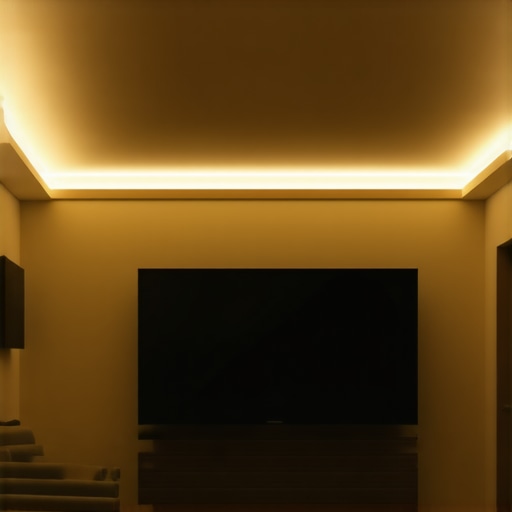
When integrating LED strips into a home theater, the focus shifts to controllability, color accuracy, and placement precision. Advanced LED systems allow for dynamic color adjustments, enabling users to tailor the lighting environment to different content genres or personal preferences. For instance, dimmable, RGBW LED strips with high CRI (Color Rendering Index) ensure that the ambient light does not distort on-screen colors, a critical factor for videophiles and content creators alike. Moreover, strategic placement—such as along ceiling coves, behind furniture, or along wall edges—can create a seamless, immersive glow that subtly guides the viewer’s focus and enhances perceived depth.
How Can Proper Lighting Design Influence Viewer Perception and Cognitive Load?
Optimal lighting design not only enhances visual comfort but also influences cognitive load and emotional response. Research in environmental psychology suggests that well-designed ambient lighting can reduce mental fatigue and improve focus, especially during prolonged viewing sessions. This is achieved by balancing light intensity and color temperature to prevent eye strain while fostering a calming atmosphere conducive to extended engagement. Additionally, advanced lighting systems can be synchronized with media content, creating synchronized light shows that elevate the sensory experience—an approach discussed in detail in expert LED strip lighting tips.
What are the technical considerations for ensuring color consistency and flicker-free operation in LED bias lighting?
Ensuring color consistency and flicker-free operation in LED bias lighting involves selecting high-quality LED drivers and controllers that support PWM (Pulse Width Modulation) at high refresh rates. This ensures smooth color transitions without perceptible flickering, which can cause eye strain or headaches over time. Furthermore, calibration using spectrometers or professional colorimeters can verify that the LED output matches the intended color temperature and saturation levels. For comprehensive guidance, consult the ultimate guide to bias lights.
For those seeking to refine their lighting systems further, I recommend exploring specialized resources or engaging with professional lighting designers to achieve a truly immersive environment. If you wish to share your insights or inquire about advanced lighting configurations, please visit our contact page.
Innovating with Dynamic Lighting Control: Pushing the Boundaries of Home Theater Illumination
Modern home theater enthusiasts are increasingly adopting sophisticated lighting control systems that integrate seamlessly with media playback, creating an immersive sensory environment. These systems utilize advanced protocols like DMX or Zigbee, allowing for synchronized light shows that respond in real-time to on-screen action, music, or user preferences. By leveraging smart home integration platforms such as Home Assistant or Hubitat, users can automate lighting scenes based on specific content genres, time of day, or even mood settings, elevating the cinematic experience to a new level of personalization.
What Role Does Human-Centric Lighting Play in Enhancing Viewing Comfort and Focus?
Emerging research underscores the significance of human-centric lighting (HCL) in optimizing viewer well-being and performance. HCL prioritizes circadian rhythm alignment by adjusting light intensity and color temperature throughout the day, reducing fatigue and enhancing alertness during extended viewing sessions. Implementing tunable white LED strips with high CRI, combined with circadian-friendly control algorithms, can mitigate the negative effects of prolonged screen time. This approach not only improves comfort but also supports overall health, making it a vital consideration for dedicated home theaters seeking long-term benefits. For a comprehensive understanding of HCL principles, consult the work of Philips Lighting’s insights on human-centric lighting.
How Can Cutting-Edge Sensor Technologies and AI Algorithms Revolutionize Home Theater Lighting Customization?
Incorporating sensor technologies such as ambient light sensors, motion detectors, and even biometric feedback devices can enable real-time, adaptive lighting adjustments that optimize visual comfort and energy efficiency. Artificial Intelligence algorithms can analyze usage patterns, environmental conditions, and viewer preferences to dynamically modify lighting scenes, ensuring consistent quality and immersion. This level of customization, once the domain of professional installations, is increasingly accessible to savvy homeowners through integrated smart systems and cloud-based AI services. Such innovations demand a nuanced understanding of both hardware capabilities and algorithmic design, emphasizing the importance of expert guidance in implementation. For detailed insights into these emerging trends, explore expert LED strip lighting tips.
If you’re eager to elevate your home theater lighting setup with the latest innovations, don’t hesitate to reach out via our contact page. Sharing your experiences or seeking tailored advice can help you achieve unmatched cinematic perfection.
The Science of Spectral Tuning: Elevating Visual Fidelity Through Precise Light Calibration
Achieving optimal home theater lighting extends beyond simple color matching; it requires a meticulous understanding of spectral power distributions (SPDs) and their impact on perceived color accuracy. Spectral tuning involves selecting LED sources and filters that closely replicate natural daylight spectra, thereby minimizing color distortions and enhancing on-screen fidelity. Researchers such as those cited in the Osram Institute for Human Centric Lighting emphasize that achieving high CRI (Color Rendering Index) values, particularly above 95, is crucial for professional-grade calibration. This process often leverages spectrometers to measure and adjust the spectral output, ensuring that ambient lighting complements the display’s color profile, rather than competing with it, thereby creating a more natural and immersive viewing experience.
Dynamic Light Field Rendering: Creating Multidimensional Atmospheres with Light Field Technology
Emerging advancements like light field rendering open new horizons for immersive home theater environments. Unlike traditional lighting that affects only surface illumination, light field technology manipulates the direction, intensity, and phase of light waves to craft multidimensional atmospheres. This approach allows for the simulation of complex lighting phenomena, such as volumetric clouds or realistic shadows, which respond dynamically to viewer movements and scene changes. Integrating light field displays with adaptive ambient lighting systems can produce a seamless, holographic-like environment that enhances depth perception and emotional engagement. While still predominantly a research domain, pioneering companies like Light Field Lab are pioneering practical applications, promising a future where lighting becomes an active participant in cinematic storytelling, rather than a passive background element.
What are the primary challenges in implementing real-time spectral and spatial control in home theater lighting systems?
Implementing real-time spectral and spatial control involves overcoming significant technical hurdles, including latency, precision calibration, and hardware integration. High-speed sensors and advanced algorithms are necessary to analyze environmental conditions instantaneously, requiring robust processing capabilities. Moreover, maintaining spectral fidelity across multiple LED sources demands sophisticated calibration routines that can adapt to aging components and environmental fluctuations. According to a comprehensive review by IEEE’s Journal of Selected Topics in Signal Processing, integrating AI-driven predictive models can optimize control strategies, but this necessitates a deep understanding of both optical physics and real-time data analytics. As these technologies mature, they will enable home theaters to dynamically adjust spectral and spatial lighting parameters, creating hyper-realistic, context-aware environments that adapt seamlessly to content and viewer preferences.
If you’re passionate about pushing the boundaries of your home theater setup, exploring these cutting-edge techniques offers a pathway to unparalleled cinematic immersion. For tailored insights and expert consultation, visit our contact page and start transforming your viewing experience today.
Harnessing Spectral Precision: The Next Frontier in Home Theater Lighting
Moving beyond basic spectral tuning, cutting-edge research emphasizes the importance of multi-spectral calibration, where LED sources are fine-tuned across multiple wavelength bands to achieve near-perfect color fidelity. This meticulous approach involves integrating high-resolution spectrometers with adaptive control algorithms, which dynamically adjust spectral outputs in real-time, thereby compensating for environmental variations and LED aging. Such advanced calibration ensures that ambient lighting enhances the display’s color accuracy, reducing perceptual discrepancies and elevating overall visual realism. Professionals leveraging these techniques report significant improvements in on-screen color reproduction, especially in HDR content, where subtle spectral nuances greatly influence viewer immersion.
Innovative Sensor Technologies: Elevating Ambient Light Adaptation
The deployment of multi-sensor arrays, combining ambient light, temperature, and even biometric sensors, allows for unprecedented responsiveness in lighting systems. For instance, integrating photodiodes with machine learning models enables the environment to self-optimize, ensuring optimal contrast and minimizing glare under varying conditions. This sensor fusion supports complex scene-aware lighting adjustments, such as dynamically shifting color temperatures to match cinematic moods or time-of-day changes. For more detailed insights into sensor integration, consult the comprehensive review by IEEE’s Journal of Signal Processing, which discusses the challenges and solutions in real-time environmental sensing for entertainment spaces.
How Can AI-Driven Lighting Algorithms Transform Viewer Experience?
Artificial Intelligence (AI) offers transformative potential by enabling predictive and adaptive lighting control based on viewer habits, content type, and environmental feedback. Leveraging deep learning models trained on vast datasets, intelligent systems can anticipate lighting needs, personalize ambiance, and synchronize lighting effects with media cues, creating a truly immersive experience. For example, AI can modulate spectral outputs to enhance depth perception during 3D movies or adjust lighting to reduce eye fatigue during marathon sessions. This intersection of AI and lighting design necessitates a sophisticated understanding of both optical physics and data science, making professional guidance invaluable for implementation. To explore this frontier, review the pioneering work outlined in expert LED strip lighting tips.
Advanced Dynamic Light Field Rendering: A New Dimension in Home Cinema
Emerging light field technologies are revolutionizing ambient lighting by enabling multidimensional control over light directionality and phase. This innovation facilitates the creation of volumetric lighting effects that can simulate realistic atmospheres—such as floating clouds or dynamic shadows—that respond seamlessly to scene changes or viewer movements. Implementing such systems involves complex hardware synchronization, including phase-controllable light sources and high-speed processing units, to render authentic spatial effects. While currently in experimental stages, collaborations between academia and industry, such as Light Field Lab, are paving the way for practical applications that promise to deepen cinematic immersion and emotional engagement.
What are the technical hurdles in deploying real-time spectral and spatial control in immersive home theaters?
Addressing the challenges of real-time spectral and spatial control requires overcoming issues related to latency, calibration accuracy, and hardware integration. High-speed, high-precision sensors and controllers must process environmental data instantaneously, demanding robust computational infrastructure. Maintaining spectral fidelity across multiple LED sources involves rigorous calibration routines, often employing spectrometers to measure spectral power distributions and adjust output accordingly. As detailed in IEEE’s Journal of Signal Processing, integrating AI-driven predictive models can optimize control strategies, but this necessitates deep expertise in optical physics, electronics, and machine learning. Mastering these complexities enables the creation of hyper-responsive, context-aware lighting environments that elevate home theater experiences to unprecedented levels.
If you aim to push the boundaries of your cinematic environment with these advanced techniques, engaging with specialized professionals and exploring innovative solutions is essential. Visit our contact page for tailored advice and expert consultation to realize your vision of ultimate home entertainment.
Expert Insights & Advanced Considerations
1. Precision Spectral Calibration Enhances Visual Fidelity
Utilizing high-resolution spectrometers and adaptive control algorithms allows for meticulous spectral tuning of LED lighting, ensuring that ambient illumination complements the display’s color profile. This precision reduces perceptual discrepancies, especially in HDR content, and elevates overall visual realism, making it a critical expert technique for discerning enthusiasts.
2. Dynamic, Scene-Aware Lighting Systems Create Immersive Atmospheres
Integrating multi-sensor arrays—ambient light, temperature, and biometric sensors—with AI-driven control enables real-time, scene-aware adjustments. This approach facilitates hyper-responsive environments that adapt seamlessly to content changes and viewer preferences, pushing the boundaries of immersive home cinema experiences.
3. Human-Centric Lighting Supports Long-Term Viewer Well-Being
Implementing tunable white LED strips with circadian rhythm alignment optimizes viewer comfort and health. Such configurations reduce eye strain and fatigue during extended sessions, emphasizing the importance of health-conscious design in professional-grade home theaters.
4. AI and Sensor Technologies Drive Personalized Lighting Experiences
Leveraging AI algorithms, combined with ambient and biometric sensors, allows for predictive and adaptive lighting adjustments. This personalization enhances depth perception, reduces eye fatigue, and elevates cinematic immersion, representing the forefront of innovative home theater lighting design.
5. Real-Time Spectral and Spatial Control Overcomes Technical Challenges
Achieving seamless spectral and spatial adjustments requires overcoming latency, calibration accuracy, and hardware integration hurdles. Advanced processing units, high-speed sensors, and sophisticated calibration routines—guided by research like IEEE’s Journal of Signal Processing—are essential to realize hyper-responsive, context-aware lighting environments.
Curated Expert Resources
- Lighting.homecinemaessentials.com: Offers comprehensive guides on LED strip selection, spectral tuning, and advanced lighting control techniques essential for professional-level customization.
- IEEE Journal of Signal Processing: Provides in-depth research on real-time environmental sensing, spectral fidelity, and adaptive control algorithms critical for cutting-edge home theater lighting systems.
- Philips Lighting’s Human-Centric Lighting Insights: Shares authoritative knowledge on circadian-friendly lighting design, supporting long-term viewer well-being and health.
- Osram Institute for Human Centric Lighting: Delivers insights into spectral power distribution and spectral tuning strategies that enhance color accuracy and visual fidelity in immersive environments.
- Light Field Lab’s Research: Explores emerging light field technologies that promise multidimensional atmospheres, setting the stage for future cinematic immersion innovations.
Final Expert Perspective
Mastering the nuances of home theater lighting, from spectral calibration to scene-aware automation, is essential for achieving cinematic perfection. These advanced insights and resources exemplify the sophisticated intersection of science and artistry that defines expert-level home theater design. For those committed to elevating their setup, engaging with specialized professionals and exploring emerging technologies will unlock unprecedented levels of immersion and visual fidelity. To delve deeper or share your insights, consider reaching out through our contact page. Your journey toward expert-level home cinema begins with informed experimentation and professional collaboration.



Leave a Reply